
Learner Journey Labs AI Ecosystem
Explore how specialized AI skills, evidence, quality checks, and human decision-making connect across the Learner Journey Labs ecosystem.
Start with the system map, then open any workflow for more detail.Learner Journey Labs AI ecosystem content
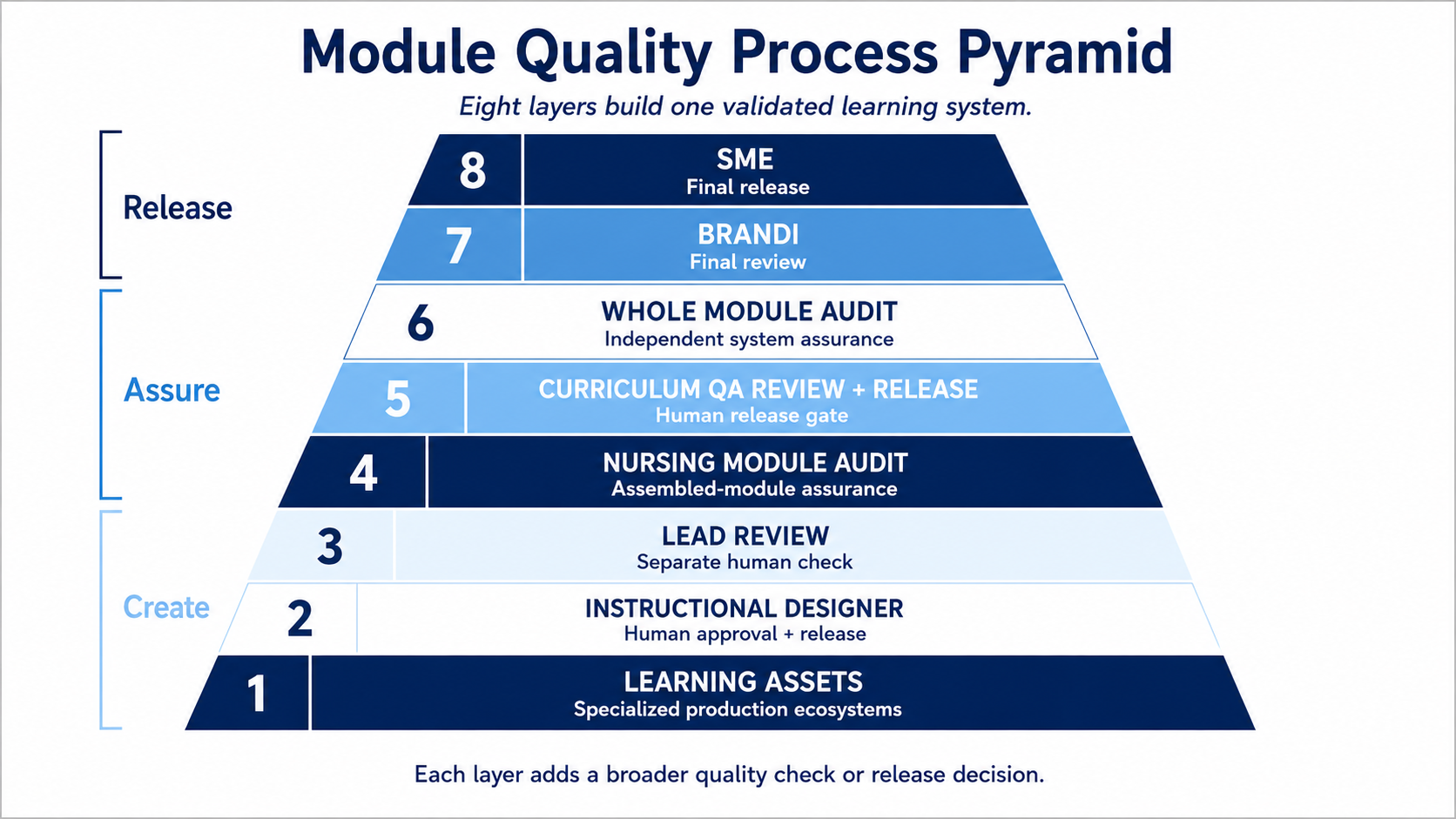
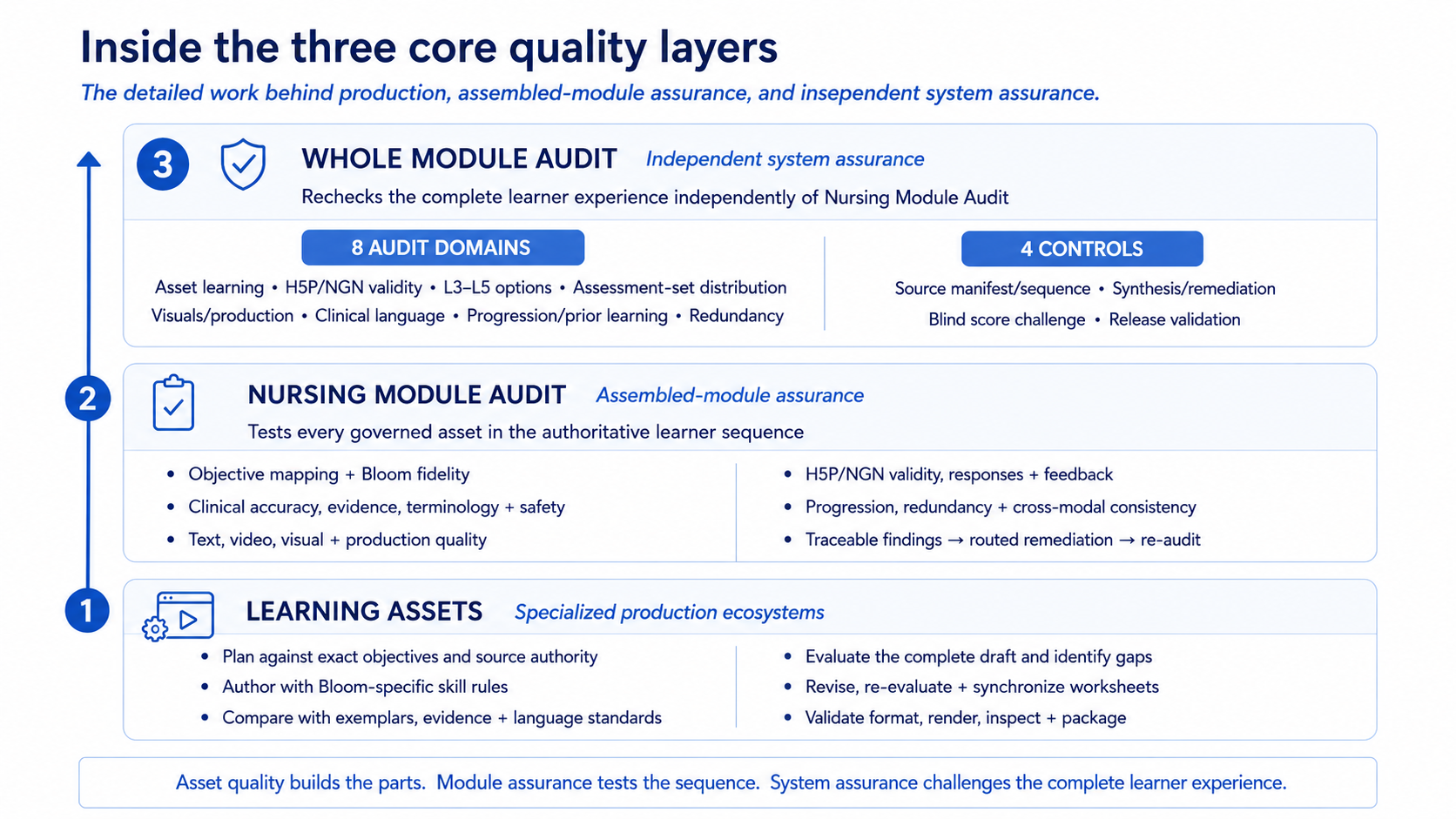
The whole system in one screen
Read this first. Open the other tabs only when you need the detail behind a stage.
Trigger: a draft criterion fails → Return to: owning specialist → Repeat: targeted repair and comparison → Exit: authoring-ready candidate
Trigger: score below 100 or open finding → Return to: correct batch and specialist → Repeat: repair, rebuild, and Nursing Module Audit → Exit: exact module at 100
Trigger: failed criterion, signal, regression, or release check → Return to: exact owner plus local and Nursing Module Audit requalification when affected → Repeat: repair and Whole-Module Nursing QA regression → Exit: Ready
Trigger: the CEO requests a change → Return to: owning skill → Repeat: every affected authoring, Nursing Module Audit, Lead, Whole-Module Nursing QA, regression, and release gate → Exit: the CEO accepts the new exact version
Start with what you are trying to do
| Your goal | Start with | Then it routes to |
|---|---|---|
| Create or revise a text page | Nursing L2–L5 Text Page Writer | Local page loop → human checkpoint → Nursing Module Audit |
| Create or revise a video script | Correct standard or LJL video-script author | Video authoring loop → approved-script handoff → Video production |
| Produce video scene images | QA Caption-Safe Video Scenes | Segment → describe → QA → generate in batches → inspect → package → Nursing Module Audit |
| Create a standalone page image | Instructional Image Description Designer | Approve description → generate separate image → inspect → insert → Nursing Module Audit |
| Create an embedded H5P or NGN | Correct L2–L5 H5P/NGN skill | Local validity → page context → assessment batch → Nursing Module Audit |
| Create a standalone NGN bank | NGN Question Bank Author | Evidence-first audit → blind re-solve → reconciliation → human release |
| Create a cumulative MCQ bank | Correct L2–L5 MCQ writer | Evidence-first MCQ audit → adversarial solve → synchronized release |
| Create a CJMM case study | CJMM authoring layer | Evidence, unfolding-state, validity, set, remediation, package, and human-review loops |
| Audit a complete module | Nursing Module Audit | Three remediation batches → Nursing Module Audit to 100 → Lead |
| Run independent final QA | Whole-Module Nursing QA Orchestrator | Eight domains → challenge → remediation → regression → CEO |
Why there are two module audits
| Audit | Plain-language purpose | What it authorizes |
|---|---|---|
| Nursing Module Audit | Primary production audit and remediation authority. It checks each module asset and its integration against the formal rubric. | A score of 100 permits separate Lead review. |
| Whole-Module Nursing QA | Independent final challenge. It reopens the exact source and tests whether the Nursing Module Audit-verified assets work together as one coherent learner experience. | Ready status permits separate CEO review. |
Show boundaries, roles, terms, thresholds, and the loop-reading key
Separate ecosystems connect without sharing the same release path
| Ecosystem | Its own release route | When it reconnects with module governance |
|---|---|---|
| Standalone NGN bank | NGN author → evidence-first audit → blind re-solve → remediation → package validation → human release | An NGN embedded in a text or video page also enters the page, Nursing Module Audit, Lead, Whole-Module Nursing QA, and CEO routes. |
| Cumulative MCQ bank | L2–L5 MCQ writers → evidence-first audit → adversarial solve → set remediation → synchronized bank release | It remains outside Nursing Module Audit and Whole-Module Nursing QA unless a separate integration contract explicitly places part of it inside module scope. |
| CJMM case study | Case authoring → evidence and unfolding-state audits → blind validity review → remediation → package validation → human release | Any module-governed text, video, interaction, or visual changed by the case returns through its owning local, Nursing Module Audit, and Whole-Module Nursing QA gates. |
Who starts work and what runs automatically
| Moment | Responsibility |
|---|---|
| Human starts | Selects the job, supplies the governing inputs, and invokes the correct authoring, audit, or orchestrator skill. |
| Specialist works | Creates or repairs only its assigned asset and runs its local comparison loop. |
| Orchestrator routes | Starts its internal subskills, validates handoffs, consolidates findings, and sends failures to the exact owner automatically. |
| Automatic means | Internal checks and routing continue after a human starts the governed workflow. It does not mean continuous operation, self-directed scope changes, or self-approval. |
| Human decides | Approves movement between governance layers, requests changes, resolves judgment conflicts, or accepts the final exact version. |
Six terms used throughout the map
| Nursing Module Audit | Nursing Module Audit—the first formal module-level scoring and batch-remediation ecosystem. |
| Whole-Module Nursing QA | Whole-Module Nursing QA—the independent final-QA ecosystem that begins only after Lead approval. |
| Governed candidate | An exact version that passed its current layer and is eligible for the next review; it is not necessarily final. |
| Targeted repair | Change only what failed and preserve every unaffected accepted component. |
| Regression | Recheck the changed area and every dependent area to prove that a repair did not create a new problem. |
| Exact version | The specific files and source fingerprint to which the evidence, scores, findings, and approvals belong. |
Visual key
| Specialist skill | Creates or repairs one specific asset type at one governed cognitive level. |
| Audit skill | Compares the actual work with fixed evidence and quality criteria. |
| Batch skill | Reads findings and routes each repair to the correct specialist without replacing that specialist. |
| Orchestrator | Coordinates multiple skills and internal handoffs after the human starts the larger workflow. |
| Human decision | Authorizes entry, resolves a conflict, or accepts/rejects an exact version. |
| Audit or orchestrator | Compares evidence with governed criteria and controls release status. |
| Batch or file handoff | Routes findings or carries state between separate workflows. |
| Quality gate | Determines pass, fail, or blocked status. |
| ↻ Closed loop | Returns work to the named earlier check until its exit condition is met. |
Quality thresholds are different gates
| Threshold | Where it applies | What it means | What it does not mean |
|---|---|---|---|
| 90 or higher plus explicit approval | Standalone page-image description | The description is eligible to be sent to image generation. | The generated image or containing page has not passed yet. |
| 9.5/10 or 95 | Video segmentation and caption-safe scene-description package | The production plan is ready for downstream image generation. | The actual scene files and video page have not passed yet. |
| 100 | Actual learner-facing asset or Nursing Module Audit | Every applicable criterion is supported by exact-version evidence and no governed change is pending. | It does not replace Lead, Whole-Module Nursing QA, or CEO review. |
| Ready | Whole-Module Nursing QA | Every applicable domain is 100, all findings and signals are closed, regression passed, and both workbooks validate. | It permits CEO review; it is not CEO’s acceptance. |
How to read every closed loop
| Loop element | Question it answers | Example |
|---|---|---|
| Trigger | What caused the loop to reopen? | A criterion failed, evidence is missing, a human requested a change, or regression found a new problem. |
| Return destination | Which exact skill owns the failed work? | A script defect returns to the video writer; an image defect returns to graphics production. |
| Repeated work | Which comparisons and dependent checks must run again? | Repair, source comparison, local validation, dependent assessment checks, Nursing Module Audit or Whole-Module Nursing QA regression as applicable. |
| Exit condition | What proves the cycle may stop? | The named gate passes on the new exact version with no unresolved work. |
Show the longer beginner walkthrough
The first authoring cycle
Start here before looking at any skill names. This first cycle creates a candidate; it does not create the final release.
What a person experiences from beginning to final output
The system is a series of governed handoffs, not one AI prompt.
Why there are many skills
| Specialization | One skill owns one type of reasoning, Bloom level, asset, or production job. Narrow ownership makes failures traceable. |
| Independent judgment | The skill that creates an asset is not the only skill deciding whether it is acceptable. |
| Controlled repair | Findings return to the specialist capable of making the smallest valid change without damaging correct work. |
| Cross-asset control | A page can be excellent alone and still fail the module because it duplicates, contradicts, or disrupts progression elsewhere. |
The five nested quality loops
Use the tabs as a map of the whole system
| Tab | What it answers |
|---|---|
| All granular steps | Shows every granular step from assignment through the authoring loop, first human review, Nursing Module Audit and three batch-remediation routes, Lead review, independent Whole-Module Nursing QA, remediation and regression, and CEO’s final decision. |
| Human checkpoints | Shows where humans review, what authority each human has, what can be returned, and why early approval is not final release. |
| Operating model | Explains the nested loops, handoffs, evidence records, and why correct components are preserved during targeted repair. |
| Roles + glossary | Distinguishes creator, evaluator, remediator, validator, human approver, the states an asset moves through, and the system’s specialized terms. |
| Nursing Module Audit | Shows the first formal module-level scoring ecosystem and its three batch-remediation loops. It ends with a Nursing Module Audit-verified module for separate Lead review. |
| Whole-Module Nursing QA · 12 subskills | Shows the independent final-QA ecosystem that begins only after Lead approval, including all 12 audit and control subskills, scoring protections, remediation, regression, workbook outputs, and release validation before separate CEO review. |
| Text | Shows L2–L5 page writing, page interaction and image dependencies, targeted revision, formal Nursing Module Audit, and re-audit to 100. |
| Video | Shows script authoring, page-level checks, SENSE or governed NURSE, embedded interactions, segmentation, scene descriptions, graphics, and video batch remediation. |
| Video production | Shows the separate post-script chain: segmentation, source reconciliation, scene descriptions, description QA, batch image generation, per-image QA, package assembly, and return to module governance. |
| Images | Shows the standalone text-page image description, approval, generation, inspection, regeneration, insertion, and page re-audit loop. Video scenes remain in Video production. |
| NGN evidence | Shows NGN authoring, evidence mapping, blind re-solving, reconciliation, and the different routes for standalone banks versus embedded interactions. |
| MCQ evidence | Shows L2–L5 MCQ authoring, evidence-first and adversarial verification, set-level repair, and the separate cumulative-bank release boundary. |
| CJMM / case studies | Shows the separate case-study authoring, evidence, validity, remediation, regression, and release ecosystem. |
| All skills | Provides the complete people-facing directory: when each skill runs, what it owns, what it returns, and which workflow receives its output next. |
The six questions a person should ask at every handoff
| Question | Why it matters |
|---|---|
| What exact version is being reviewed? | Scores and approvals belong only to the files and source fingerprint that were actually checked. |
| What gate has passed? | A local writer pass, Nursing Module Audit 100, Lead approval, Whole-Module Nursing QA 100, and CEO acceptance authorize different things. |
| What can still fail later? | A strong asset can still fail cross-asset progression, redundancy, terminology, assessment distribution, production, or human-fit review. |
| What evidence proves the result? | The current asset, worksheet, source map, workbooks, validator results, render inspection, manifest, and finding-closure record make the decision auditable. |
| Who owns the next action? | The human starts a separate workflow when required; the orchestrator or batch routes internal work to the correct specialist. |
| If this changes, which gates reopen? | The change-impact route prevents both under-reviewing a consequential edit and needlessly redoing unaffected work. |
What a skill is and what happens inside one
Worked example: Nursing Level 4 Text Page Writer
Technology inside a skill
| Component | What it does |
|---|---|
| Trigger and task mode | Determines whether the run is drafting, evaluating, revising, making one eligible targeted repair, or checking finalization. |
| Authority hierarchy | Resolves conflicts among fixed objectives, the human's newest decision, exemplars, the worksheet standard, clinical safety, scope, and progression. |
| References and exemplars | Supply the exact cognitive, clinical, language, architecture, and quality standards used for comparison. They calibrate quality without becoming copied content. |
| Structured working record | Stores source traceability, planning decisions, comparison evidence, revisions, unresolved gaps, and the final readiness decision in a machine-checkable form. |
| Builder and template | Turns the structured record into the required staff-facing worksheet or production artifact using the governed layout. |
| Validators | Check required fields, exact versions, objective traceability, prohibited shortcuts, artifact integrity, synchronization, and release preconditions. |
| Render inspection | Checks what a person will actually see: clipping, overflow, blank fields, broken tables, awkward page breaks, and readability. |
| Output contract | Defines the exact deliverables, their order, required links, evidence, status wording, and which downstream ecosystem receives them. |
| Blocker behavior | Stops release when required proof cannot be generated or validated instead of silently substituting an incomplete result. |
Human-centered design inside a skill
| Human need | How the system protects it |
|---|---|
| Intent stays human-owned | The person defines the objective, audience, constraints, protected content, and what success means. |
| Decisions remain reviewable | The worksheet shows why content was selected, how it maps to the objective, what comparisons were made, and what changed. |
| Accepted work is preserved | Repairs target the smallest valid scope and name content that must not change. |
| Uncertainty stays visible | Missing evidence, clinical uncertainty, policy dependence, limitations, and unresolved findings remain explicit instead of being hidden behind fluent prose. |
| Quality is inspectable | Humans receive the learner-facing artifact plus planning evidence, validator results, render evidence, and a readiness decision. |
| Approval is separate from creation | A writer may declare authoring readiness, but independent audits and authorized humans control movement and final release. |
Trigger: any comparison dimension is Partial, Missing, or Repair → Return to: the earliest failed planning or authoring decision → Repeat: revise architecture, sections, analytical story, explanations, diagnostic certainty, and prose in at least three substantive dimensions for Draft or Revise mode → Exit: the second comparison proves the complete exact page passes every authoring gate
Trigger: the structured record or page fails a deterministic rule → Return to: the exact failed worksheet field or learner-facing passage → Repeat: correct, resynchronize, and rerun the validator against both versions → Exit: the pre-document validator passes
Trigger: any rendered worksheet page is visually or structurally defective → Return to: the structured record, builder input, or document layout owner → Repeat: correct, rebuild, rerender, and reinspect every affected page → Exit: every worksheet page is readable and complete
Trigger: the final validator, render evidence, DOCX integrity, or working-link contract fails → Return to: the owning internal step or explicit human blocker → Repeat: correct and replay every affected check while preserving passed work → Exit: the exact package passes or a concrete blocker is reported without releasing incomplete content
What travels through the skill
| State | Artifact carried forward | Why it matters to a person |
|---|---|---|
| Human request | Objective or page goal, audience, constraints, optional sources, context, protected content, and accepted decisions. | The system starts from human intent rather than inventing the assignment. |
| Planning state | Structured worksheet record with source inventory, traceability, reasoning map, exemplars, preservation rules, and known gaps. | The invisible reasoning becomes inspectable and correctable. |
| Draft state | One complete internal first draft bound to the planning record. | The system has something concrete to compare; fluency alone is not treated as quality. |
| Revision state | Comparison findings, named first-draft defects, substantive revisions, and a new exact candidate. | A person can see that revision occurred and why the page changed. |
| Evidence state | Synchronized worksheet, exact first and final versions, validator results, render evidence, DOCX, fingerprint, readiness, and unresolved gaps. | The decision is tied to evidence for one exact version rather than a generic assurance. |
| Authoring handoff | Working worksheet link, final candidate page, exemplar comparison, and readiness decision. | The human receives both the learner experience and the staff-facing proof behind it. |
Who each output is for
| Output type | Examples | Primary audience and purpose |
|---|---|---|
| Learner-facing content | Text page · video page · H5P · embedded NGN · standalone NGN · MCQ · instructional image | Learners. Delivers the approved instructional experience without exposing internal planning or QA language. |
| Human-facing QA evidence | Thinking-proof worksheet · evaluation workbook · remediation workbook · exemplar comparison · readiness explanation | Authors, reviewers, Leads, SMEs, and the CEO. Makes reasoning, findings, required changes, preservation rules, and approval status understandable. |
| Machine-checkable records | Structured worksheet record · source fingerprint · normalized manifest · finding ledger · validator result · exact-version hash | Validators, orchestrators, and downstream skills. Proves identity, completeness, traceability, synchronization, and gate status without replacing human judgment. |
| Production files | Rendered DOCX · segmented script · image-description document · separate image files · title image · one approved cast thumbnail with the full cast facing the viewer · manifest | Production teams and build systems. Carries approved content into the actual learner-facing implementation. |
| Final release package | Exact approved module · accepted assets · validated Nursing Module Audit and Whole-Module Nursing QA evidence · remediation closure · version record | The CEO and the downstream build, upload, publication, delivery, or archival workflow. Identifies the only version authorized for final use. |
Trigger: Nursing Module Audit records a text-page finding or score below 100 → Return to: QA Batch for Text Pages, then this exact L4 skill in Revise mode—or Targeted Repair only for one eligible isolated language substitution → Repeat: the full applicable worksheet, comparison, validation, render, Nursing Module Audit rebuild, and regression checks → Exit: the exact page and module reach 100 with every applicable finding closed
Complete governed path from request to CEO-approved output
The asset passes three human checkpoints and two distinct module-level QA ecosystems. No earlier checkpoint is the final release.
What each checkpoint authorizes
| Checkpoint | What has passed | What the approval allows | What it does not mean |
|---|---|---|---|
| Human checkpoint 1 | Authoring and local validation | The candidate may enter Nursing Module Audit. | Not module verified and not final. |
| Nursing Module Audit | Formal Nursing Module Audit score 100 and finding closure | The exact module may be presented to the Lead. | Not independently verified by Whole-Module Nursing QA. |
| Lead checkpoint | Nursing Module Audit-verified module plus Lead judgment | The module may enter independent Whole-Module Nursing QA. | Not CEO-approved and not final. |
| Whole-Module Nursing QA | Eight domains at 100, remediation complete, release validation passed | The exact release candidate may be presented to the CEO. | Technical readiness is not final human acceptance. |
| CEO checkpoint | All governed QA plus final human judgment | The exact version becomes the accepted final output. | Later revisions are new governed versions. |
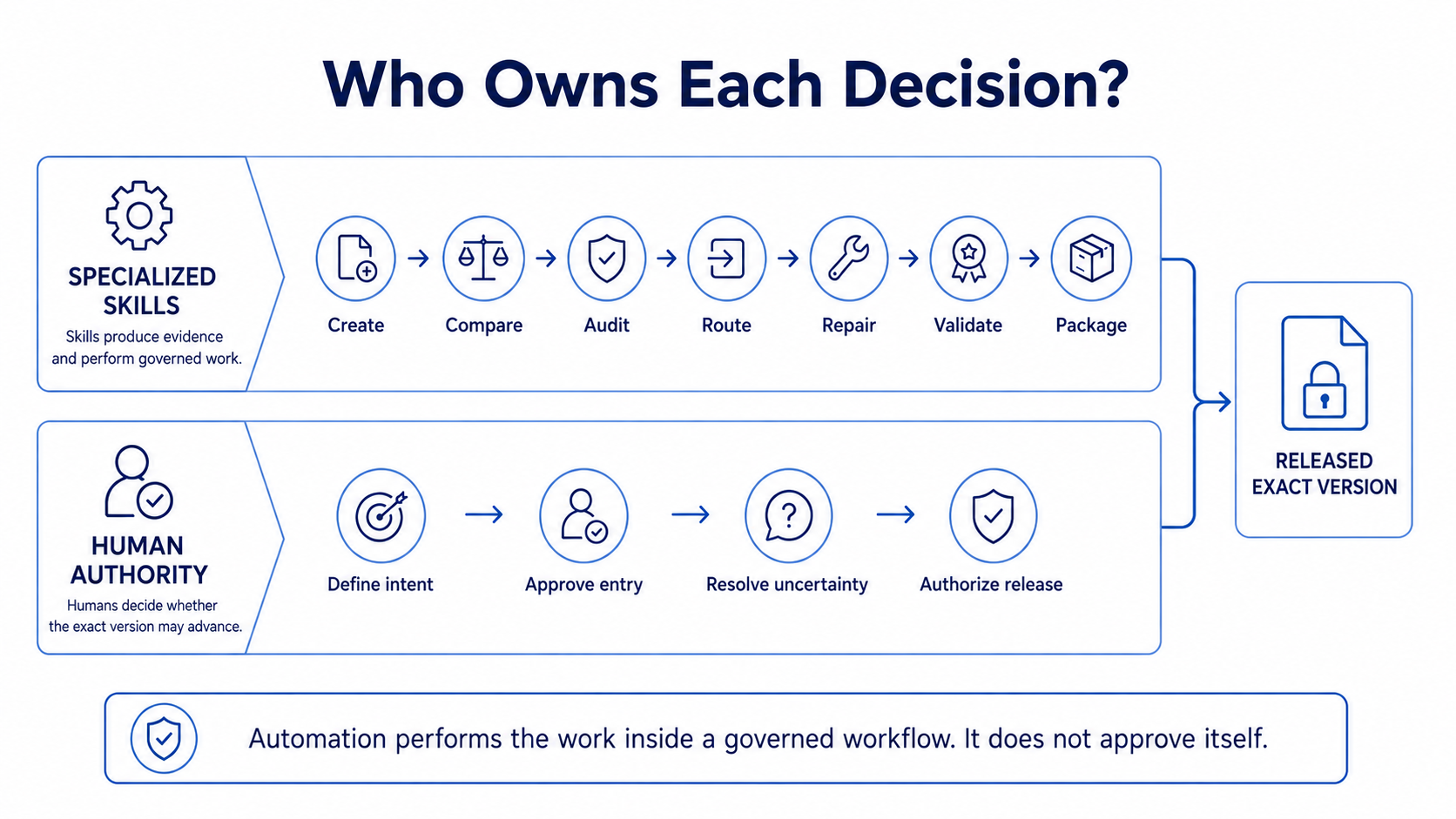
The three human quality checkpoints sit outside the audit systems
Each human makes a separate judgment between governed ecosystems. Only the CEO accepts the final output.
Human checkpoints
| Checkpoint | Human responsibility | System responsibility |
|---|---|---|
| Intake authority | Define the source, objective, Bloom level, asset, boundaries, preservation rules, and required deliverables. | Validate routing, task mode, package scope, dependencies, and source sufficiency before authoring. |
| Human checkpoint 1 | Review the first governed candidate and approve or reject entry into Nursing Module Audit. | Route feedback to the owning authoring skill and rerun affected local gates before resubmission. |
| Lead checkpoint | Review the exact Nursing Module Audit-verified version and approve or reject entry into Whole-Module Nursing QA. | Send Lead findings through the applicable text, video, or assessment batch and repeat Nursing Module Audit. |
| CEO checkpoint | Perform the final human review of the Whole-Module Nursing QA-verified release candidate and accept it or request another governed revision. | Classify CEO's feedback, reopen all affected authoring, Nursing Module Audit, batch, Lead, Whole-Module Nursing QA, regression, and release gates, and return a new exact candidate. |
| Blocker authority | Resolve missing evidence, conflicting instructions, protected-content decisions, or required scope changes at any stage. | Stop only the affected path, preserve verified work, and resume from the interrupted gate after resolution. |
What “output” means at each stage
| Output level | Who sees it | Status |
|---|---|---|
| Working draft | Specialist and local quality loop | Not final. Still being compared, scored, repaired, or validated. |
| Audit output | Orchestrator, batch skill, and human when useful | Evaluation evidence and remediation instructions; not the finished learner-facing artifact. |
| Verified asset | Batch and whole-module ecosystem | Passed its local gate but may still fail cross-asset progression, redundancy, terminology, or distribution review. |
| Authoring candidate | Initial human reviewer | Passed authoring gates and is eligible to enter Nursing Module Audit. |
| Nursing Module Audit-verified module | Lead | Exact module version reached Nursing Module Audit 100 and is eligible for Lead review. |
| Lead-approved module | Whole-Module Nursing QA | Approved by the Lead to enter the independent eight-domain final-QA ecosystem. |
| Whole-Module Nursing QA release candidate | CEO | All applicable Whole-Module Nursing QA domains reached 100 and release validation passed. |
| CEO-accepted final | Downstream audience or production workflow | Approved by the CEO for the intended use. Later changes create a new version and governance cycle. |
Human and governed-system swimlanes
Each approval moves the exact version into the next QA layer.
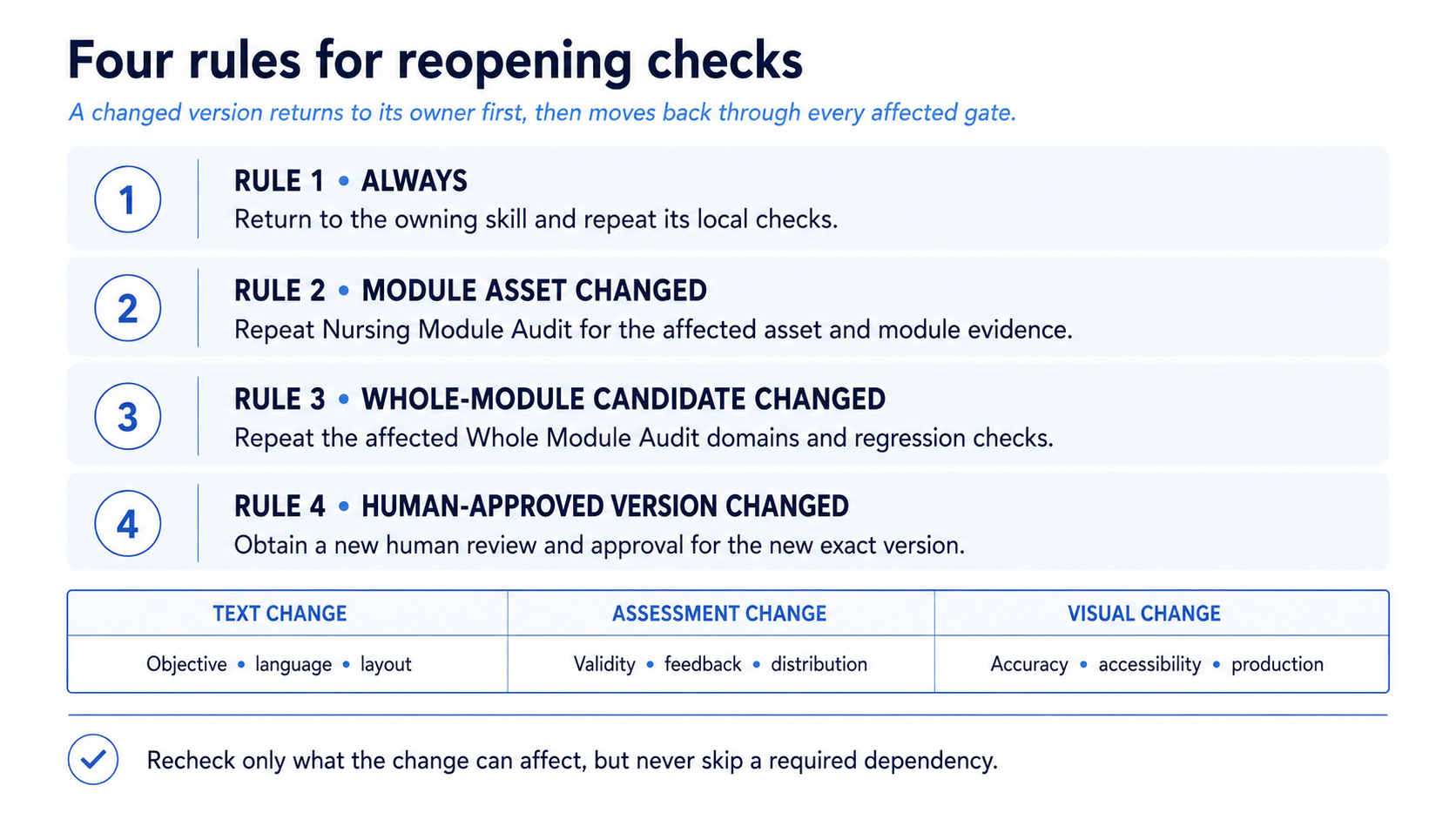
How a person actually operates the ecosystem
Some actions occur automatically inside a skill. Separate workflows and file handoffs are deliberately started by the human.
Choose the entry point
| What you need | What the human runs | What the system does next |
|---|---|---|
| Create a text page | Correct L2, L3, L4, or L5 Text Page Writer | Authors, compares, evaluates, repairs, and rechecks the page; embedded interactions and visuals enter their own supporting loops. |
| Create a video page | Correct level-specific Video Script Author | Authors and audits the script/page, then routes approved narration through segmentation, scene descriptions, graphics, and production QA. |
| Create an embedded H5P or NGN | Correct L2, L3, L4, or L5 H5P/NGN Designer | Builds and validates the interaction in the context of its text or video page, then enters module-level assessment review. |
| Create a standalone NGN bank | NGN Question Bank Author | Maps the complete bank to evidence, then routes it through evidence-first audit, blind re-solving, reconciliation, and packaging. |
| Create a cumulative MCQ bank | Correct Nursing MCQ Level 2, 3, 4, or 5 skill | Authors the bank and routes it through the separate evidence-first MCQ audit. It does not enter Nursing Module Audit. |
| Run primary module audit | Nursing Module Audit | Audits the complete current module, creates the Nursing Module Audit workbook pair, and routes findings through the three remediation batches until the exact version reaches 100. |
| Run independent final module QA | Whole-Module Nursing QA Orchestrator | Runs only after Lead approval, executes eight independent domains, challenges scores, coordinates remediation, and validates the CEO-review release candidate. |
| Repair module findings | QA Batch for Text Pages, Batch QA Video, and QA Batch for Assessments | Each batch reads the workbooks, routes every finding to its owning specialist, verifies the repair, and rebuilds the content master. |
| Produce instructional visuals | Relevant description designer followed by the approved image-generation skill | Descriptions are evaluated before generation; generated outputs enter a separate visual QA and targeted regeneration loop. |
What each connector means
| Automatic call | A governing skill invokes a required internal check or subskill without another human prompt. |
| Human trigger | The person deliberately starts a separate workflow, normally after reviewing an output or receiving a workbook. |
| File handoff | State moves through a content master, workbook, script, description document, bank, package, or revision record. |
| Quality gate | A pass or fail decision determines whether work advances or returns to revision. |
| Blocker | The system stops the affected path because evidence, authority, a dependency, or a required decision is missing. |
Entry and exit for each workflow
| Workflow | Entry | Exit |
|---|---|---|
| Text | Objective, Bloom level, source, module context | Authoring-ready page and worksheet, followed by separate Nursing Module Audit scoring |
| Video | Objective, source, level, page and production requirements | Authoring-ready video package, followed by separate Nursing Module Audit scoring |
| Embedded H5P/NGN | Page objective and taught content | Valid interaction in local page and module context |
| Standalone NGN | Objectives, evidence, Bloom, package specification | Evidence-reconciled, blind-verified bank package |
| MCQ | Objectives, source, Bloom, item and set requirements | Adversarially verified cumulative bank |
| Nursing Module Audit | Complete current content master and governed assets | Nursing Module Audit-verified module at 100 for Lead review, or an explicit blocker report |
| Whole-Module Nursing QA | Lead-approved Nursing Module Audit-verified exact version | Eight-domain-verified release candidate for CEO review |
The literal module workflow
This is the operational path between separate runs.
Files carry the system state
| Artifact | Created by | Consumed by | Purpose |
|---|---|---|---|
| Content master | Human and production team | Whole-module and batch workflows | Authoritative collection of learner-facing module assets. |
| Nursing Module Audit workbook pair | Nursing Module Audit | Three batch skills, human reviewer, and Lead | Records formal Nursing Module Audit scores, exact findings, repair routes, and finding closure. |
| Whole-Module Nursing QA workbook pair | Whole-Module Nursing QA | Whole-Module Nursing QA remediation routes and CEO | Records eight-domain evidence, challenge-verified scores, cross-domain findings, remediation, and release validation. |
| Revised asset | Owning specialist | Local audit and batch verifier | Contains the smallest valid repair and preserves accepted work. |
| Rebuilt master | Batch or Whole-Module Nursing QA remediation workflows | Nursing Module Audit or Whole-Module Nursing QA | Reassembles verified repairs for the appropriate regression and re-audit loop. |
| Release package | Whole-Module Nursing QA | CEO | Contains the Whole-Module Nursing QA-verified exact candidate, Nursing Module Audit and Whole-Module Nursing QA evidence, remediation status, manifest, limitations, and blocker status. |
Source-of-truth hierarchy
Quality-gate hierarchy
Passing one gate never implies that every later gate has passed.
Which gates reopen after a change
| Change | Required rechecks | Why |
|---|---|---|
| Grammar or formatting only | Language, formatting, preservation | Confirm the edit is clean and did not alter clinical meaning or protected layout. |
| Clinical claim or nursing action | Evidence, safety, scope, timing, escalation, reassessment, cross-asset consistency | A narrow clinical change may affect several learner-facing assets and assessments. |
| Learning objective or Bloom level | Authoring, Bloom, page, interaction, assessment, distribution, whole module | The governing target changed, so every dependent asset must be remapped. |
| H5P, NGN, or MCQ key | Evidence, response validity, distractors, rationale, feedback, blind re-solve, set consistency | Changing the key changes the logic of the entire item, not only one cell. |
| Video narration | Script audit, page alignment, interaction mapping, segmentation, scene descriptions, affected graphics | Production assets must remain synchronized with the approved narration. |
| Image, icon, overlay, or label | Description match, accuracy, accessibility, text purpose, caption safety, continuity | The visual may change what the learner sees, infers, or can access. |
| Terminology rule | Every affected text, video, H5P, NGN, and MCQ asset | Shared language governance prevents corrected terms from being reintroduced elsewhere. |
What the system can and cannot guarantee
| Can systematically enforce | Still requires human authority |
|---|---|
| Objective and Bloom alignment | Final instructional intent and stakeholder preference |
| Evidence mapping and clinical consistency | Local institutional policy when it is not supplied |
| Language, scope, terminology, and prohibited wording | Approval to change protected or politically sensitive content |
| Redundancy, progression, assessment validity, and distribution | Whether the release candidate fits the real delivery environment |
| Traceable findings, repair ownership, and recheck status | Final acceptance, publication, or downstream use |
Human feedback that routes cleanly
| Weak feedback | Governable feedback |
|---|---|
| “Make it better.” | “Shorten the L4 explanation without removing the cue-comparison reasoning.” |
| “Fix the images.” | “Preserve all existing images except Scene 4; regenerate Scene 4 because the icon does not reinforce the teaching text.” |
| “The questions feel wrong.” | “Recheck Items 8–12 for multiple defensible answers and repeated abstract L4 stem wording.” |
| “Change the video.” | “Revise the narration in Scene 6, then reopen segmentation, description, and graphics gates only for affected scenes.” |
What happens when the system is blocked
A blocker is controlled behavior, not a failed attempt to guess.
Worked complete-module example
One module can open several local loops, two module-level audit loops, and three human checkpoints.
Who does what
These are different responsibilities, not different names for “the AI.”
| Role | Responsibility | Boundary |
|---|---|---|
| Human requester | Defines the exact objective or page goal, Bloom level, asset type, audience, constraints, preserve/do-not-touch rules, accepted decisions, and available source or context required by the selected workflow. | Approves the first governed candidate for Nursing Module Audit but does not create final release authority. |
| Lead reviewer | Reviews the exact Nursing Module Audit-verified module after the Nursing Module Audit remediation loop reaches 100. | Approves entry into independent Whole-Module Nursing QA or returns findings through the Nursing Module Audit batch loop. |
| CEO | Performs final human review after all applicable Whole-Module Nursing QA domains reach 100 and release validation passes. | Accepts the exact final output or reopens every governance layer affected by the requested change. |
| Orchestrator | Determines which audits and routes must run, reconciles results, manages dependencies, and issues workbooks and release status. | Does not replace the specialist skills that author or repair individual assets. |
| Specialist author or designer | Creates or repairs one defined asset type at one governed cognitive level. | Does not make the final whole-module release decision. |
| Audit skill | Compares the actual asset with the governing rubric and records criterion-specific evidence and exact findings. | Does not silently rewrite the asset or award a perfect score from template language. |
| Batch skill | Reads audit workbooks, identifies the owning skill, applies targeted remediation routes, verifies repairs, and rebuilds the master. | Does not replace the level-specific writer or designer. |
| Validator | Checks required files, contracts, dependencies, versions, package structure, deterministic rules, and release preconditions. | Does not independently establish clinical or instructional quality. |
| Whole-module auditor | Judges progression, redundancy, consistency, clinical language, assessment validity, distribution, and scoring integrity across the full module. | Does not substitute for the local asset-level audit loop. |
How an asset changes governance state
Each state authorizes entry into the next layer; only the last state is final.
Plain-language glossary
| Skill | A governed executable work contract combining a defined job, task modes, authority hierarchy, references, exemplars, templates, structured records, builders, validators, quality gates, blocker behavior, exact outputs, and downstream handoff rules—not merely a prompt. |
| Audit | Evidence-based comparison of the actual asset with fixed criteria. |
| Batch | A coordinator that remediates many identified assets by routing each finding to its proper owner. |
| Targeted repair | Preserve correct work and modify only the failed criterion and its necessary dependencies. |
| 100 | No changes pending, with asset-specific evidence supporting every perfect criterion. |
| Evidence-first | Claims and keys must be independently supported rather than accepted because the original writer intended them. |
| Synchronized release | Connected skills, validators, standards, evidence, workbooks, and packaged outputs agree before release. |
| H5P | An interactive learning activity embedded in a page or video, such as a decision, classification, sequence, or response task. |
| NGN | A Next Generation NCLEX-style interaction or case that requires learners to use clinical judgment with evidence from a scenario. |
| MCQ | A multiple-choice question. In this system, cumulative MCQ banks have their own authoring, evidence, adversarial-review, and release workflow. |
| SENSE | The governed instructional structure used by applicable video-script skills to organize learner noticing, interpretation, and reasoning. |
| NURSE | The nursing video reasoning framework: Notice, Understand, Recognize, Select, and Evaluate. |
| Bloom level | The required cognitive job: L2 Understand, L3 Apply, L4 Analyze, or L5 Evaluate. The level controls what learners must think and do. |
| Source fingerprint | A stable identifier for the exact collection of files being checked. A changed file creates a changed governed version. |
| Regression check | A repeat test of the repaired area and its dependencies to prove the fix did not create a new defect elsewhere. |
| Evidence-ineligible | A claim, placeholder, description, stale file, or unverified output that cannot be used to prove a quality criterion passed. |
| Nursing Module Audit | Nursing Module Audit: the first formal module-level scoring and batch-remediation ecosystem. |
| Whole-Module Nursing QA | Whole-Module Nursing QA: the independent final-QA ecosystem that runs after Lead approval and before CEO review. |
| CJMM | Clinical Judgment Measurement Model. A standalone unfolding case follows the separate CJMM ecosystem; a heading-only CJMM Case Study label is recorded but is not itself a scored asset. |
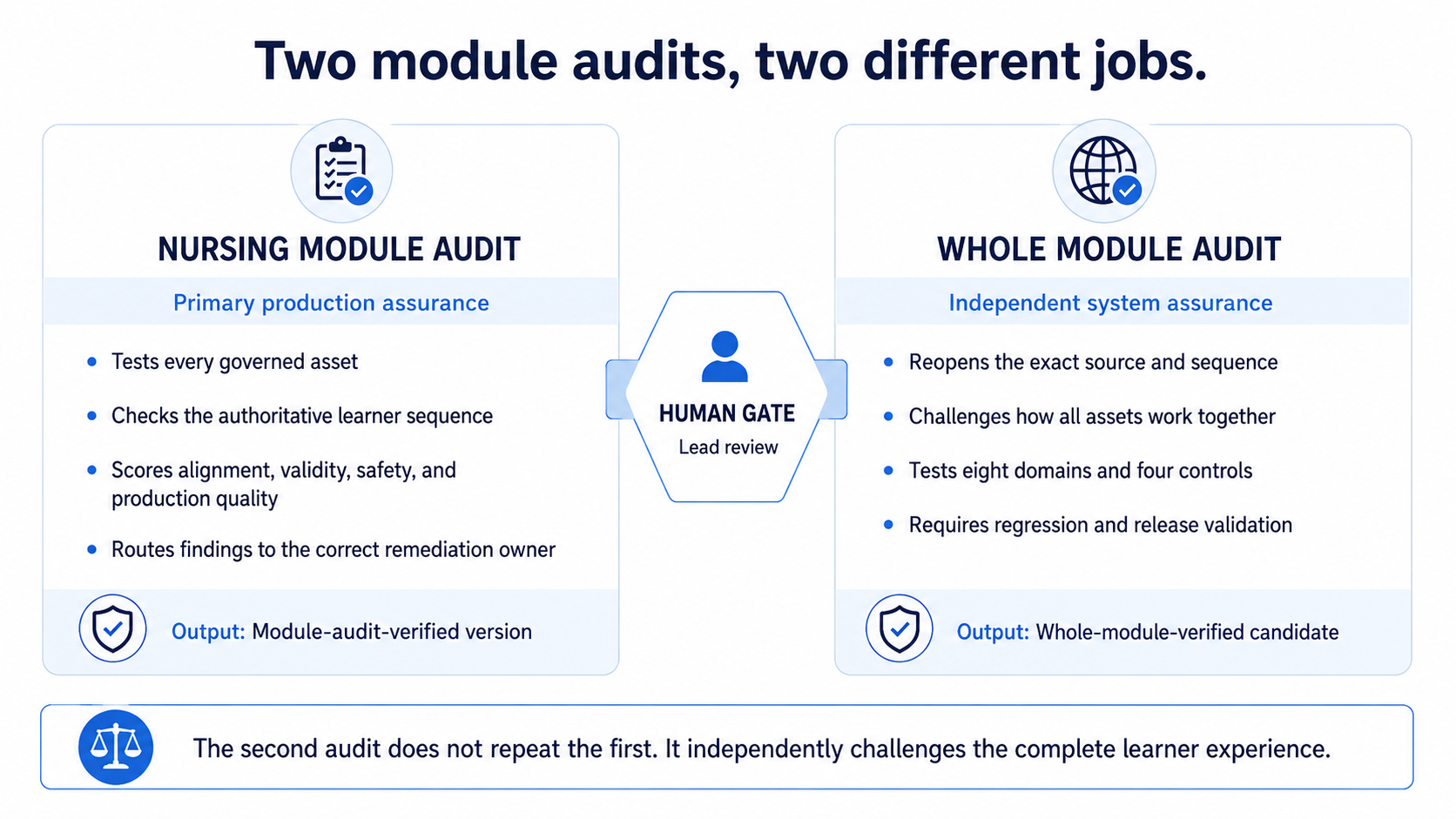
Nursing Module Audit is its own formal QA ecosystem
It begins after the first human approves the authoring candidate and ends before the separate Lead checkpoint.
Nursing Module Audit and batch skill descriptions
| Skill | What it does | How it interacts |
|---|---|---|
| Nursing Module Audit | Evaluates individual text pages, video pages, and their embedded H5P/NGN interactions against the asset-level rubric. | Acts as the inner audit gate for text and video authoring. Its findings return to the same level-specific writer until the asset passes. |
| Nursing Assessment Language Standard | Provides the shared learner-facing rules for nursing terminology, stems, options, prompts, feedback, scope, and prohibited wording. | Governs text, video, H5P, NGN, and MCQ skills so a term corrected in one ecosystem is not reintroduced by another. |
| QA Batch for Text Pages | Reads text-page findings, identifies the failed criterion and Bloom level, and routes each repair to the correct L2–L5 writer or page-asset skill. | Preserves correct content, applies the smallest valid repair, calls Nursing Module Audit again, and repeats until the page reaches 100. |
| Batch QA Video | Reads video-page findings and routes them to the correct script writer, page assessment designer, segmenter, scene writer, or graphics skill. | Rechecks the repaired video page through Nursing Module Audit and returns unresolved visual or interaction findings to the exact owning skill. |
| QA Batch for Assessments | Reads H5P and embedded NGN findings and routes them to the matching L2–L5 H5P/NGN designer. | Repeats validity, Bloom, evidence, answer-key, and feedback checks until the interaction clears its local page context and returns to Nursing Module Audit. |
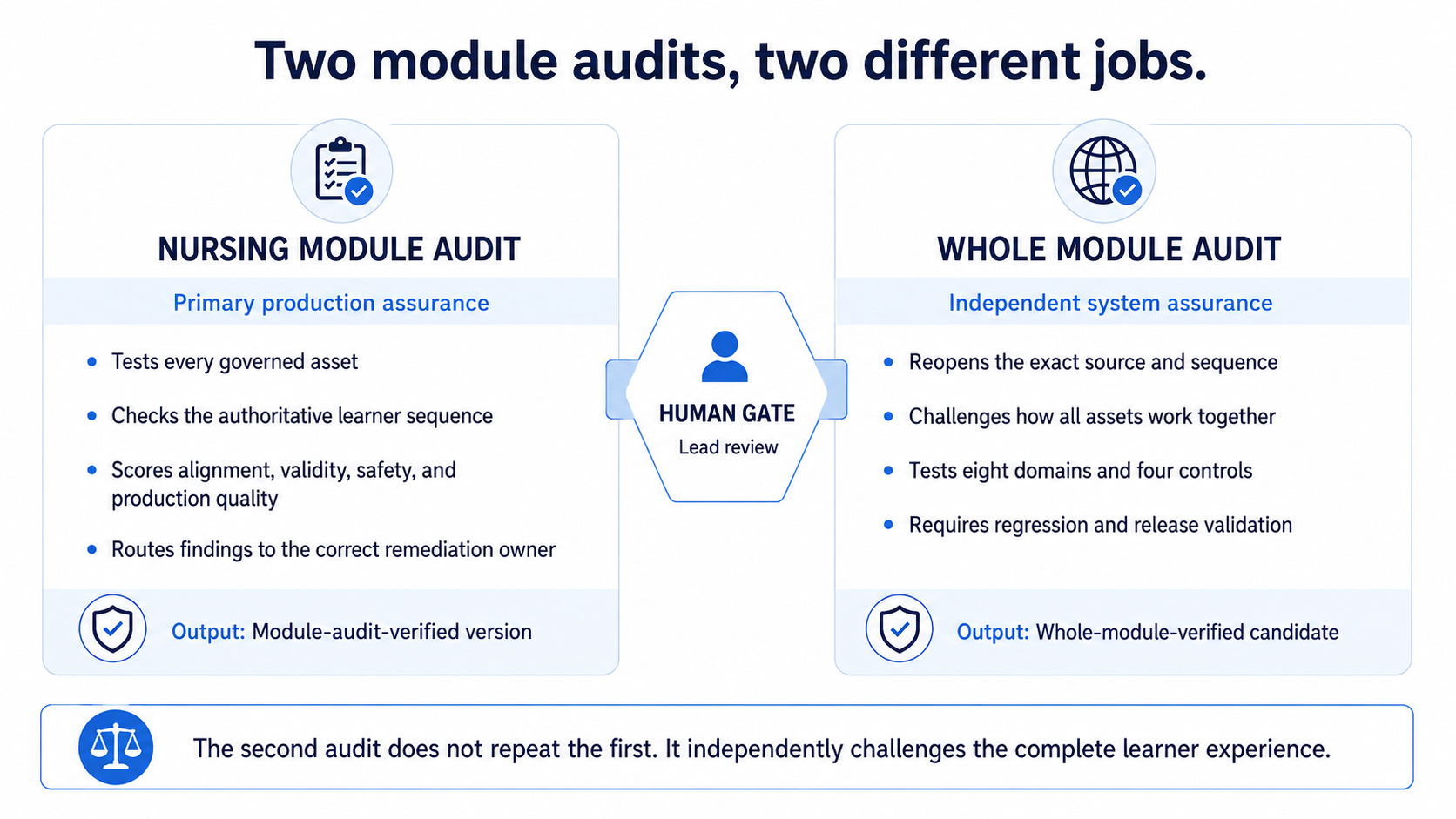
Whole-Module Audit: independent system assurance
This is the assurance layer above Nursing Module Audit and the standalone NGN and MCQ evidence audits. It evaluates how the verified parts function together as one complete learner experience.
Whole-Module Nursing QA preflight before any subskill can score
| Preflight control | What Whole-Module Nursing QA requires | Why it matters |
|---|---|---|
| Complete current source | Content master plus every referenced learner-facing text page, video page or script, exact H5P and eligible NGN, visual evidence, captions, alt text, objectives, and authoritative learner order. | Nursing Module Audit workbooks may be evidence, but they never substitute for reopening and independently checking the actual source assets. |
| Deterministic source index | Every nonblank paragraph, table record, and media file receives a stable record ID and source hash. | Every score, quote, visual claim, finding, and remediation task can be traced to the exact source version. |
| Normalized manifest | Module identity, source-set fingerprint, exact objective text, authoritative sequence, stable asset/interaction/visual/concept IDs, expected coverage, and one disposition for every indexed record. | Prevents missing rows, duplicate coverage, stale evidence, and audit records that silently disappear. |
| Scored boundary | Only substantive text pages, substantive video pages or scripts, their embedded H5Ps or eligible NGNs, and their visuals are scored. | Heading-only labels, dividers, navigation, empty shell sections, Walk With Me, and CJMM Case Study are recorded but do not create scores or deductions. |
| Sequence authority | Use an explicit source-declared order when present; otherwise use complete Content Master document order. | A separate sequence file is optional and is never a blocker when the Content Master already establishes learner order. |
How the 12 subskills actually run
Trigger: Whole-Module Nursing QA repair changes a governed asset → Return to: owning specialist → Repeat: affected local gates and Nursing Module Audit on the changed exact version when applicable → Exit: the requalified exact asset returns to Whole-Module Nursing QA
Trigger: failed criterion, unresolved signal, missing proof, workbook defect, or release check → Return to: exact earlier owner → Repeat: repair, requalification, dependent-domain regression, workbook reconciliation, and release validation → Exit: Ready or an explicit Not ready / Score withheld state
The 12 Whole-Module Nursing QA subskills and what each one does
| Subskill | What it checks | Evidence and anti-inflation controls | Successful output | Failure route |
|---|---|---|---|---|
| 1 · Whole-Module Asset Learning Audit | Every substantive text and video asset's objective, intended Bloom, learner task, completeness, instructional function, clinical teaching, and relationship to its parent module. | Requires one source-bound evidence row per expected asset, every governed criterion exactly once, affirmative passing proof, boundary testing, and a unique evidence key. | Validated Asset Content & Learning handoff with exact coverage, source-bound criterion evidence, proposed scores, findings, and signals ready for semantic challenge. | Returns atomic findings to the owning L2–L5 text or video author and reopens dependent page, assessment, progression, redundancy, and Whole-Module Nursing QA checks. |
| 2 · Whole-Module H5P/NGN Validity Audit | Every exact embedded H5P and eligible NGN: objective mapping, Bloom, scenario necessity, cues, responses, key, feedback reasoning, and parent-page fit. | Requires one row for every manifest interaction ID. A parent-page or bank-summary row cannot stand in for its child interactions. | Validated Individual H5P/NGN Validity handoff containing exactly one complete evidence row for every manifest interaction ID. | Routes through QA Batch for Assessments to the exact L2–L5 H5P/NGN designer and reopens the containing page when context changes. |
| 3 · Whole-Module Option Validity Audit | L3–L5 response options for multiple defensible answers, weak or implausible distractors, cueing, asymmetry, shortcut answering, cognitive-level collapse, and keyed reasoning. | Independently tests the easiest legitimate answer path, strongest competitor, counterevidence, and whether one answer remains clearly best. | Validated L3–L5 Option Validity handoff with one source-bound option judgment, strongest-competitor analysis, findings, and signals per applicable interaction. | Returns the affected interaction or assessment to its level-specific writer and rechecks key, rationale, feedback, item validity, and related set-level effects. |
| 4 · Whole-Module H5P/NGN Set Audit | The complete embedded assessment set for objective coverage, Bloom and learning-job distribution, repeated scenarios, cue saturation, answer-pattern concentration, feedback overload, assessment-order leakage, and unused taught sibling topics. | Uses one scored MODULE-SET row plus a complete source-bound semantic fingerprint inventory for every interaction; inventory items do not receive duplicate set scores. | Validated H5P/NGN Set Distribution handoff with one MODULE-SET score row and a reconciled fingerprint inventory for every interaction. | Routes only the items needed to repair the set through QA Batch for Assessments, then reruns individual and set-level validity. |
| 5 · Whole-Module Visual Production Audit | Whether required page and video visuals are present, accurate, readable, accessible, instructionally purposeful, synchronized, caption-safe, clinically safe, and production-ready. | Uses indexed media or structural hashes and actual rendered evidence; a description, placeholder, or filename cannot substitute for the final visual file. | Validated Visual/Production handoff covering every expected visual with actual-file evidence, accessibility and production judgments, findings, and signals. | Routes to the description designer, page-image generator, segmenter, scene writer, graphics skill, or manual production repair according to the root cause. |
| 6 · Whole-Module Clinical Language Audit | Clinical accuracy, evidence support, safety, entry-level RN scope, terminology, timing, escalation, reassessment, policy dependence, and contradictions across text, video, interactions, and visuals. | Requires exact source references, tests competing interpretations and policy dependence, and separates a shared root cause from its cross-modal consequences. | Validated Nursing Scope/Clinical Safety/Language handoff with source-specific evidence, cross-modal contradiction records, findings, and clinical-verification routes. | Routes to every affected asset owner, the shared language standard, or manual clinical verification; dependent domains replay after repair. |
| 7 · Whole-Module Progression Audit | Whether prior learning advances across the authoritative sequence—from foundations through application, analysis, and evaluation—without gaps, invalid entry assumptions, or higher levels restarting from scratch. | Every progression row requires earlier and later asset IDs, increasing sequence positions, exact references for both, learner tasks, reasoning change, and a controlled decision. | Validated Progression/Coverage handoff with exact earlier-later comparisons, learner entry states, reasoning changes, decisions, findings, and regression scope. | Returns to the earliest upstream asset causing the progression gap and every dependent page or assessment affected by the change. |
| 8 · Whole-Module Cross-Asset Redundancy Audit | Every recurring concept family across text, video, examples, H5Ps, and NGNs; distinguishes purposeful reinforcement from repeated full beginner teaching. | Uses one complete module-set concept ledger, canonical and later source references, teaching-job comparison, restart-from-scratch test, allowed-repetition reason, and compression decision. | Validated Cross-Asset Redundancy/Streamlining handoff with one complete concept ledger, one comparison for every recurring family, and exact compression decisions. | Routes the later duplicate to compress as a bridge, remove, or rewrite for progression while preserving the canonical teaching owner. |
| 9 · Source-Blind Semantic Score Challenge | Rejudges every governed criterion after hiding all proposed numeric scores, ratings, and prior audit conclusions. | Reopens the exact indexed source; records a 0–4 verified score, affirmative proof, boundary test, counterevidence, rationale, unique evidence key, and source refs. Only this challenge score can enter Whole-Module Nursing QA. | Challenge-verified criterion scores and discrepancy decisions—or an explicit withheld score when the exact source cannot prove the criterion. | Withholds an unproved score, rejects boilerplate or repeated evidence, reconciles discrepancies, and returns invalid handoffs for repair before synthesis. |
| 10 · Whole-Module Remediation Planner | The consolidated finding ledger after all eight domains validate; groups root causes, detects conflicts, orders dependencies, and creates one executable repair task per finding. | Every task requires exact location, one required change, content to preserve, route, dependencies, acceptance criteria, verification method, regression scope, and matching source fingerprint. | Validated dependency-ordered remediation roadmap with one atomic, traceable, executable task for every finding. | Routes each atomic task to the owning specialist. A proposed repair never closes a finding and the planner never adds points. |
| 11 · Whole-Module Nursing QA Executor | Implements an approved remediation roadmap or verifies revised assets when the user asks for execution. | Requires actual revised evidence—not suggested wording—and checks that every repair satisfies its acceptance test without damaging protected content. | Verified revised assets, completion evidence, updated finding status, and the exact regression scope ready for Nursing Module Audit requalification and Whole-Module Nursing QA replay. | Replays the affected domain, dependent assessments, contradiction checks, progression, redundancy, and score; unresolved work returns to the owning route. |
| 12 · Workbook Compilation and Release Validation | Builds the separate Whole-Module Nursing QA evaluation and remediation workbook pair, reconciles all handoffs and ledgers, and runs the final pre-release plus read-only validation. | Checks sheet order and schemas, source fingerprint, exact coverage, score recomputation, weights, primary score ownership, finding-remediation reconciliation, atomicity, execution routes, regression, consumer cells, data-only readability, formula errors, signals, and readiness. | Validated Whole-Module Nursing QA evaluation and remediation workbooks plus Ready, Not ready, or Score withheld status bound to the exact source version. | Any failed check blocks release, leaves the score blank or status Not ready/Score withheld as governed, and returns the specific defect to the proper earlier subskill. |
Whole-Module Nursing QA scoring weights and what a score of 100 means
| Domain | Weight | 100 requires |
|---|---|---|
| Asset Content & Learning | 15% | Every applicable criterion verified at 4/4 with source-specific proof and no open asset-learning work. |
| Individual H5P/NGN Validity | 15% | Every exact interaction independently covered and fully valid. |
| L3–L5 Option Validity | 10% | Every applicable response set supports one defensible best answer without shortcuts or ambiguity. |
| H5P/NGN Set Distribution | 10% | The complete module set is balanced, distinct, and free of open distribution findings. |
| Visual/Production | 10% | All required actual visuals and production evidence pass. |
| Nursing Scope/Clinical Safety/Language | 15% | No open clinical, scope, safety, terminology, timing, escalation, reassessment, or contradiction finding. |
| Progression/Coverage | 15% | The authoritative sequence demonstrates supported cognitive progression without gaps. |
| Cross-Asset Redundancy/Streamlining | 10% | Every recurring concept has a justified teaching job or an executed streamlining repair. |
Whole-Module Nursing QA evaluation workbook
| Executive Summary | Validated score, readiness, blockers, plain-English eight-domain scorecard, and actual required changes. |
| Governed Score Ledger | Weights, coverage, recomputed domain scores, findings, signals, and validation. |
| Eight domain detail tabs | Asset, interaction, option, set, visual, clinical, progression, and redundancy evidence. |
| Assessment QA Handoff | Diagnostic bridge to QA Batch for Assessments; never claims authoritative Nursing Module Audit item scores. |
| Finding Ledger + Remediation Roadmap | Atomic findings, owners, dependencies, preservation, acceptance, verification, and regression. |
| Rubric and Score Caps + Release Validation | Visible scoring rules and check-specific release evidence. |
Whole-Module Nursing QA remediation workbook
| README | Plain operating instructions and status meaning. |
| Content To Do | Text and video work routed to the owning skills. |
| H5P To Do | Embedded interaction work routed to assessment QA. |
| Finding Remediation | One-to-one source of truth matching the evaluation Finding Ledger. |
| Visual To Do | Filtered visual and production repairs. |
| Clinical Verification | Every open clinical-language finding requiring source or human verification. |
| Verification Log | Actual completion evidence, regression results, and finding closure. |
Lead review, Whole-Module Nursing QA, and CEO review are three separate authorities
| Stage | Type | Input | Decision or output | What it cannot claim |
|---|---|---|---|---|
| Lead review | Human checkpoint before Whole-Module Nursing QA | Nursing Module Audit-verified exact module at 100 | Approves entry into Whole-Module Nursing QA or returns the module through the Nursing Module Audit remediation loop. | Does not run Whole-Module Nursing QA, create its score, or create final acceptance. |
| Whole-Module Nursing QA | Independent governed QA ecosystem | Lead-approved Nursing Module Audit-verified exact version | Runs 12 subskills and produces a Whole-Module Nursing QA-verified release candidate only after every governed release condition passes. | Does not replace Lead judgment or CEO's final human decision. |
| CEO review | Human checkpoint after Whole-Module Nursing QA | Whole-Module Nursing QA-verified exact release candidate | Accepts the exact version as final for intended use or requests a governed revision. | Does not retroactively become part of Whole-Module Nursing QA; a requested change creates a new version and required rechecks. |
What happens when a text-page skill runs
The writer owns authoring readiness. Nursing Module Audit separately owns the formal score and finding closure.
Responsibility and routing at a glance
| Human starts | Runs automatically inside the workflow | Human decision | Output |
|---|---|---|---|
| Choose the L2–L5 writer and provide the exact objective, source, page context, constraints, and protected content. | The writer builds its worksheet, drafts, compares, revises, validates, renders, and packages the exact page; Nursing Module Audit findings route through QA Batch for Text Pages. | Approve the authoring-ready page for Nursing Module Audit; later the Lead and CEO independently accept or return exact versions. | A CEO-accepted page inside the released exact module—not merely an AI draft or writer-ready page. |
What each pass does
| Loop station | Detailed action | Quality standard enforced |
|---|---|---|
| 1 · Lock inputs | Reads the exact MLO/EO or page goal, assigned Bloom level, source content, module context, required format, existing audit findings, and any preserve/do-not-touch instructions. | Prevents scope drift, invented objectives, unsupported teaching, accidental image changes, and work outside the requested asset. |
| 2 · Draft | Builds the page using the level-specific teaching job: L2 explains foundations; L3 applies findings in focused nursing situations; L4 analyzes relationships and priorities; L5 evaluates whether care is safe, complete, and effective. | Maintains Bloom fidelity, entry-level RN scope, clinically accurate sequencing, and an appropriate amount of teaching for the page goal. |
| 3 · Compare | Compares every major claim and instructional move with the supplied source, objective, existing module content, Nursing Assessment Language Standard, related page interactions, and any Whole-Module findings. | Detects contradictions, unsupported additions, terminology drift, duplication, missing prerequisite links, and higher-level pages that reteach lower-level content from scratch. |
| 4 · Evaluate | Runs Nursing Module Audit criterion by criterion and records asset-specific evidence for clinical accuracy, objective alignment, Bloom, instructional completeness, learner language, assessment alignment, visual readiness, and release status. | A 100 cannot be assigned from template language or assumption; every perfect criterion requires evidence from the actual page and no pending correction. |
| 5 · Targeted repair | Routes each failed criterion back to the same writer or the exact supporting skill. The repair changes only what failed, preserves correct material, and updates connected H5P/NGN, worksheet, terminology, or visual description only when the finding requires it. | Prevents wholesale rewrites, regression, unnecessary page growth, broken formatting, and new inconsistencies introduced while fixing a narrow problem. |
| 6 · Re-audit | Re-runs the affected criteria and the dependency checks, confirms the repair did not damage previously correct content, reconciles all findings, and repeats the full loop if any issue remains. | Release occurs only at 100 with no changes pending; the verified page then returns to the batch skill and ultimately to Whole-Module Nursing QA for cross-asset review. |
Text-page skill descriptions
| Skill | What it owns | Comparison and revision role |
|---|---|---|
| Nursing L2 Text Page Writer | Creates foundational pages that help learners explain, distinguish, classify, organize, sequence, or interpret essential nursing concepts. | Compares the page with the exact objective and source, checks foundational completeness without application-level overreach, repairs failed Nursing Module Audit criteria, and repeats until 100. |
| Nursing L3 Text Page Writer | Creates application-focused pages in which learners use taught cues, rules, and nursing actions in focused clinical situations. | Checks that the scenario is necessary, that learners must apply rather than recall, and that the page does not reteach all L2 content; revises and re-audits until 100. |
| Nursing L4 Text Page Writer | Creates analysis-focused pages that connect cue clusters, competing explanations, priorities, safety, and QSEN-style rescue reasoning. | Compares relationships across findings instead of listing facts, removes abstract wording and lower-level reteaching, repairs exact Nursing Module Audit failures, and re-runs the audit until 100. |
| Nursing L5 Text Page Writer | Creates evaluation-focused pages in which learners judge whether a plan or response is safest, complete, effective, timely, and appropriately reassessed. | Checks the explicit criteria used for judgment, evidence sufficiency, escalation and reassessment logic, then revises failed criteria and re-audits until 100. |
| Nursing Level 2 H5P/NGN Designer | Builds page interactions that interpret, classify, sequence, or distinguish taught L2 content. | Compares the interaction with the page’s exact objective and taught evidence; revises cues, options, key, and feedback until local and whole-module validity gates pass. |
| Nursing Level 3 H5P/NGN Builder | Builds focused application interactions that require learners to use page content in a necessary scenario. | Checks scenario necessity, action selection, option validity, and feedback reasoning; returns failures to the interaction and page context for another audit. |
| Nursing Level 4 H5P/NGN Designer | Builds analysis interactions involving cue relationships, pattern changes, prioritization, or competing clinical interpretations. | Checks that the analysis cannot be answered by recall, that all cues are functional, and that keyed reasoning is evidence-grounded; revises until the validity loop passes. |
| Nursing Level 5 H5P/NGN Designer | Builds evaluation interactions requiring judgment against explicit safety, completeness, effectiveness, timing, or reassessment criteria. | Compares every response with the stated criteria and evidence, repairs ambiguity or unsupported judgment, and repeats validity review until release. |
| Instructional Image Description Designer | Creates production-ready descriptions for standalone instructional page images from the page objective and taught content. | Checks that each visual teaches a necessary concept, is clinically safe and feasible, matches the page, and has no unsupported anatomy, procedure, product, or text requirement. |
| Instructional Text Page Images | Generates the final standalone instructional image only from a complete approved description. | Returns any inaccurate, unreadable, noncompliant, or instruction-mismatched image to regeneration; the final page cannot receive visual completion credit until the actual image is present. |
| QA Batch for Text Pages | Coordinates remediation across every text page identified in the whole-module workbooks. | Routes each finding to the exact writer or page-asset skill, protects correct content and images, verifies the revised page with Nursing Module Audit, and repeats until 100. |
| Nursing Module Audit | Provides the governing asset-level rubric and evidence requirements used inside every text-page loop. | Compares the actual page with the objective, Bloom level, clinical and language standards, interaction alignment, and visual state; it releases only when no criterion still needs repair. |
Concrete Level 4 text-page cycle
- The Nursing L4 Text Page Writer locks the L4 objective, source content, existing module progression, and any Nursing Module Audit or Whole-Module findings.
- It drafts an analysis page built around relationships among cues, changing patterns, competing priorities, and safe nursing decisions instead of restating foundational facts.
- It compares the draft with the source, L4 Bloom requirements, language rules, earlier pages, related H5P/NGN content, and the Nursing Module Audit rubric.
- Nursing Module Audit evaluates the actual draft with criterion-specific evidence. Any score below 100 must include a concrete repair instruction.
- The L4 writer receives only the failed criteria, makes the smallest valid repair, preserves correct content, and checks that the repair did not create new redundancy, scope drift, or contradictions.
- Nursing Module Audit runs again. This closed cycle repeats until the page scores 100 with no changes pending; QA Batch for Text Pages then returns the verified page to the rebuilt module for Whole-Module Nursing QA.
Video-page authoring and quality loop
Script, page, interaction, segmentation, description, and graphics work remain separate but connected quality loops.
Responsibility and routing at a glance
| Human starts | Runs automatically inside the workflow | Human decision | Output |
|---|---|---|---|
| Choose the correct standard or LJL video writer and provide the objective, Bloom level, sources, framework, assessment requirements, and filename. | The writer compares and repairs the script/page; embedded interactions route to their designers; Nursing Module Audit findings route through Batch QA Video. | Approve the exact script handoff to production; later the Lead and the CEO separately review the governed video package. | An approved exact script handoff first; after production and governance, a CEO-accepted learner-facing video page and package. |
Video ecosystem skill descriptions
| Skill | What it does | How it compares and loops |
|---|---|---|
| Nursing Level 2 Video Script Author | Authors L2 scripts that help learners explain, distinguish, organize, sequence, or interpret nursing content using the governed SENSE structure. | Compares narration and SENSE elements with the exact objective, source, learner level, and language rules; repairs failed criteria and rechecks until the script and page pass. |
| Video Level 3 Script | Authors application-level scripts from fixed outcomes, source content, design notes, and assessment requirements. | Checks that learners use taught knowledge in a focused situation, that the scenario is necessary, and that embedded assessment aligns; revises and re-audits until release. |
| Nursing Level 4 Video Script Author | Authors analysis-level scripts and embedded interactions involving cue relationships, changing patterns, prioritization, and rescue reasoning. | Compares each segment with L4 evidence and scenario logic, removes lower-level reteaching, repairs invalid cues or reasoning, and repeats Nursing Module Audit. |
| Nursing Level 5 Video Script Author | Authors evaluation-level scripts requiring judgment of safety, completeness, effectiveness, timing, escalation, and reassessment. | Checks that judgments use explicit criteria and sufficient evidence; repairs unsupported conclusions and re-runs the quality gate. |
| LJL Nursing Level 3 NURSE Video Script Author | Creates L3 scripts using the project NURSE sequence: Notice, Understand, Recognize, Select, and Evaluate. | Checks that each NURSE phase performs a distinct application job, aligns to the objective, and does not duplicate teaching; failed phases return to targeted revision. |
| LJL Nursing Level 4 NURSE Video Script Author | Creates L4 analysis scripts using NURSE to connect cues, interpretations, choices, and evaluation. | Compares each phase with analysis-level evidence and removes steps that collapse into recall; revisions repeat until phase and whole-script audits pass. |
| LJL Nursing Level 5 NURSE Video Script Author | Creates L5 evaluation scripts using NURSE to judge whether nursing decisions meet explicit clinical criteria. | Checks evidence sufficiency, decision criteria, escalation, and reassessment; returns unsupported judgments to the writer until the audit clears. |
| Nursing Video Blurb Writer | Creates the learner-facing introduction, transition, and closing while preserving the exact script filename. | Compares the blurb with the video’s actual objective and level, removes promises the video does not fulfill, and returns mismatches to revision. |
| Video Script Segmenter | Removes headings and assessment blocks, preserves the complete approved narration, and divides it into production-ready stationary-image scenes. | Checks source-to-segment completeness, visual-state stability, sentence integrity, and excluded material; resegments until the approved production contract passes. |
| Visual Transition Script Segmenter | Segments narration into visually distinct scene blocks for downstream storyboard and image-description work. | Compares adjacent scenes for a real visual change, prevents long static holds or arbitrary splits, and repeats segmentation when a scene has no distinct visual job. |
| Caption-Safe Scene Writer | Turns approved scene text into production-ready descriptions with layout, cast, teaching text, icon decisions, and caption-safe composition. | Classifies each scene as teaching overlay or illustration-only, tests whether text teaches, evaluates icon candidates for conceptual reinforcement, and revises descriptions that fail. |
| QA Caption-Safe Video Scenes | Orchestrates segmentation, scene-description QA, text-purpose checks, icon decisions, and release scoring. | Loops rejected scenes back to the segmenter or scene writer until the complete package passes, then authorizes graphics production. |
| Caption-Safe Illustrated Graphics | Generates caption-safe static video artwork from approved descriptions and character references. | Uses batch manifests, inspects every image, protects accepted files, and regenerates rejected or missing scenes only. |
| Batch QA Video | Routes whole-module video findings to the exact script, page, interaction, segmentation, description, or graphics skill. | Re-runs Nursing Module Audit after targeted repair and continues routing until the video page and package have no unresolved findings. |
| L2–L5 H5P/NGN Designers | Create Bloom-matched interactions embedded in video pages. | Compare cues, responses, key, and feedback with the script and objective; invalid interactions return through QA Batch for Assessments and the video-page audit. |
| Nursing Module Audit | Evaluates the complete learner-facing video page, not only the narration. | Checks script, page, objective, Bloom, clinical language, interaction alignment, progression, and supporting asset readiness; findings return to the owning video skill. |
Video production is a separate ecosystem after script approval
It converts one approved exact script into a reconciled segmented script, approved descriptions, separate generated scene files, and a verified production package. It is not the video-authoring loop and it is not the standalone text-page-image loop.
Responsibility and routing at a glance
| Human starts | Runs automatically inside the workflow | Human decision | Output |
|---|---|---|---|
| Hand off the approved exact script and choose the governing segmenter contract. | QA Caption-Safe Video Scenes coordinates segmentation, reconciliation, description QA, scoring, packaging, and targeted returns; graphics production generates and inspects scene batches. | Authorize the production run and resolve escalations; the Lead and CEO review only after the actual package re-enters module governance. | A reconciled segmented script, approved scene descriptions, accepted individual images, manifest, and governed video-production package. |
Trigger: missing, duplicated, reordered, broken, or visually unstable scene text → Return to: selected segmenter → Repeat: split or merge failed boundaries, score, and source-to-segment reconciliation → Exit: at least 9.5/10 with no fidelity or visual-state defect
Trigger: a scene, text-purpose, icon, title, cast, anatomy, caption-safe, filename, or package check fails → Return to: Caption-Safe Scene Writer or segmenter → Repeat: revise rejected descriptions, rescore, and reconcile the full set → Exit: the complete description package reaches its release threshold
Trigger: a generated file is rejected, missing, corrupt, mismatched, or newly fails regression → Return to: graphics generation for that file only → Repeat: regenerate, inspect at full size, preserve accepted finals, and reconcile manifest and count → Exit: every required scene is accepted and the manifest is complete
Trigger: any material script, description, image, package, Nursing Module Audit, Lead, Whole-Module Nursing QA, or CEO finding → Return to: the earliest owning step affected by the change → Repeat: all dependent production checks plus applicable Nursing Module Audit and Whole-Module Nursing QA regression → Exit: the new exact package again clears every reopened gate
Video-production skills and responsibilities
| Skill or layer | Owns | Does not own |
|---|---|---|
| Video Script Segmenter | Remove headings and H5Ps, preserve retained narration, create and score stationary-image scenes, and enforce one stable visual state. | Does not write descriptions or generate images. |
| Visual Transition Script Segmenter | Preserve all supplied source wording and create visually distinct scene text blocks when headings are intentionally retained. | Does not replace the production route that must remove headings and assessments. |
| Caption-Safe Scene Writer | Write production-ready descriptions and apply text, icon, layout, cast, caption, clinical-presentation, and one-frame gates. | Does not generate final images unless downstream generation is explicitly included. |
| QA Caption-Safe Video Scenes | Orchestrate segmentation QA, scene-description QA, scoring, reconciliation, and documents-only packaging. | Does not generate the final artwork. |
| Caption-Safe Illustrated Graphics | Generate and inspect separate caption-safe images in resumable batches while protecting accepted files. | Does not decide script fidelity or repair narration. |
| Batch QA Video | Route Nursing Module Audit video findings to the exact script, assessment, segmentation, description, or graphics owner. | Does not replace any specialist owner. |
| Nursing Module Audit | Score the actual video page, production evidence, visuals, embedded interactions, clinical language, progression, and readiness. | Does not replace upstream authoring or production skills. |
| Whole-Module Nursing QA visual-production lane | Independently challenge whether actual visuals are present, accurate, accessible, purposeful, synchronized, and production-ready. | Does not author scenes or generate images. |
Standalone text-page image ecosystem
This tab owns page-image descriptions, explicit generation authorization, one-file generation, inspection, insertion, and page re-audit. Caption-safe video scenes are now broken out in the separate Video production tab.
Responsibility and routing at a glance
| Human starts | Runs automatically inside the workflow | Human decision | Output |
|---|---|---|---|
| Provide the approved page, objective, placement, evidence boundaries, and visual teaching need. | The description designer compares, scores, and revises the specification; after explicit approval, the image skill generates and inspects one file at a time. | Explicitly approve the description for generation, then approve the actual inserted image through page and module review. | One accepted instructional image placed in the page with accessibility evidence, followed by Nursing Module Audit on the rendered page. |
Text-page image flow
Image ecosystem skill descriptions
| Skill | What it owns | How it compares and loops |
|---|---|---|
| Instructional Image Description Designer | Designs and scores the complete specification for one standalone instructional page image before generation is allowed. | Compares the visual with the exact page objective, source evidence, learning purpose, placement, accessibility, cognitive load, clinical restrictions, and feasibility; requires purposeful revision and explicit generation approval. |
| Instructional Text Page Images | Generates one original instructional image from one complete, approved description. | Inspects the actual file at full size for accuracy, readability, exact instruction match, accessibility, and technical integrity; regenerates only the failed image and escalates after the bounded retry path. |
| Nursing Module Audit | Evaluates visual integration in the actual learner-facing text page. | A description or generated file cannot earn release by itself; the rendered page must support the objective, avoid contradiction and answer leakage, meet accessibility and placement requirements, and clear the applicable criteria at 100. |
NGN evidence, validity, and independent-review assurance
This is a formal assurance ecosystem at the same governance tier as Nursing Module Audit. It independently tests NGN evidence, clinical and cognitive validity, cueing, scoring, item function, set quality, and release readiness.
What the NGN evidence audit contains
| Assurance layer | Specific checks | Required evidence or output |
|---|---|---|
| Objective and source evidence | Maps the scenario, exhibits, cues, task, response model, key, rationale, and feedback to the exact objective, Bloom level, learner scope, and approved evidence. | Traceable item-level evidence map with no unsupported clinical claim, response, or scoring decision. |
| Clinical and cognitive validity | Checks clinical accuracy, safety, entry-level RN scope, scenario necessity, cue sufficiency, reasoning demand, and whether the item truly performs its stated L2–L5 cognitive job. | One defensible reasoning path at the intended Bloom level without requiring knowledge that was not taught or sourced. |
| Cueing and answer leakage | Tests whether wording, option patterns, repeated terminology, unequal specificity, exhibit structure, grammatical fit, response counts, or feedback language reveals the key or allows test-wise guessing. | A cue-free learner version in which the correct response is supported by clinical evidence rather than surface clues. |
| Response model and scoring | Verifies the NGN format, selectable elements, response limits, keyed combinations, partial-credit logic when applicable, rationale consistency, and feedback for correct and incorrect pathways. | Synchronized learner item, faculty key, rationale, feedback, and scoring specification. |
| Blind independent review | A reviewer re-solves the item without seeing the original key or author rationale, records the selected response and reasoning, and identifies ambiguity, missing cues, competing keys, or unsupported assumptions. | Blind-solve record kept separate from the original-key review until comparison. |
| Reviewer reconciliation | Compares the authored key, evidence audit, and blind solution; investigates every disagreement instead of resolving it by majority vote or deference to the author. | Documented resolution, targeted repair when needed, and a new blind check on the repaired exact version. |
| Item-function and measurement quality | Reviews cognitive load, likely difficulty, discrimination risk, distractor or response functioning, construct-irrelevant complexity, fairness, accessibility, and format fit before administration. | Pre-administration item-function judgment. Statistical psychometrics are added only when learner-response data are available. |
| Set and package assurance | Checks objective coverage, format and cognitive distribution, repeated assessment jobs, redundancy, answer-pattern risk, workbook synchronization, file integrity, and exact-version identifiers. | Validated bank or embedded-item package with every finding closed and every component synchronized. |
Responsibility and routing at a glance
| Human starts | Runs automatically inside the workflow | Human decision | Output |
|---|---|---|---|
| Select standalone-bank or embedded-page scope and provide objective, Bloom level, evidence, learner scope, and package requirements. | Authoring maps every element to evidence; the evidence-first audit verifies, blind re-solves, reconciles, and routes atomic repairs to the owning NGN skill. | Release a validated standalone bank, or approve an embedded NGN to continue through assessment batch, Nursing Module Audit, Lead, Whole-Module Nursing QA, and CEO. | A synchronized evidence-qualified bank, or a governed embedded interaction inside the final module. |
NGN ecosystem skill descriptions
| Skill | What it does | How it compares and loops |
|---|---|---|
| NGN Question Bank Author | Builds original standalone or unfolding-case NGN banks from exact objectives, Bloom levels, learner scope, and approved evidence. | Maps each cue, exhibit, task, response, key, and rationale to evidence; repairs findings from blind re-solving and evidence audit until the package is synchronized and releasable. |
| Evidence-First NGN Question Bank Audit | Audits, remediates, blind re-solves, reconciles, and packages NGN banks using evidence-grounded keyed reasoning. | Separates original-key review from blind solving, records disagreements, requires reconciliation, and returns every failed item to the author before final release. |
| Nursing Level 2 H5P/NGN Designer | Creates L2 interactions requiring interpretation, classification, sequencing, or distinction of taught evidence. | Checks exact page objective and taught content; revises any cue, response, key, or feedback that exceeds or misses L2. |
| Nursing Level 3 H5P/NGN Builder | Creates L3 application interactions in necessary focused scenarios. | Compares the required nursing action with taught rules and scenario cues; repairs items answerable by recall or unsupported inference. |
| Nursing Level 4 H5P/NGN Designer | Creates L4 interactions based on cue relationships, pattern changes, or competing interpretations. | Checks cue necessity, relationship analysis, response validity, and keyed reasoning; returns ambiguity or recall-level tasks to redesign. |
| Nursing Level 5 H5P/NGN Designer | Creates L5 interactions requiring judgment against explicit safety, completeness, effectiveness, timing, or reassessment criteria. | Compares every choice with the stated criteria and evidence; unsupported judgments loop back to authoring. |
| QA Batch for Assessments | Routes embedded H5P/NGN findings to the exact level-specific designer. | Rechecks local interaction validity, page context, and whole-module set distribution after every repair. |
| Whole-Module H5P/NGN Validity Audit | Checks every embedded interaction individually and as a set across the module. | Detects objective gaps, repeated assessment jobs, invalid responses, weak feedback, and distribution problems; findings return through the assessment batch loop. |
| Nursing Assessment Language Standard | Controls learner-facing scenario, prompt, response, rationale, and feedback language. | Prevents terminology drift and prohibited wording from reappearing during remediation. |
MCQ evidence, psychometric quality, and independent-review assurance
This is a formal assurance ecosystem at the same governance tier as Nursing Module Audit. It independently tests evidence, one-best-answer validity, cueing, distractor function, Bloom demand, psychometric quality, bank distribution, and release readiness.
What the MCQ evidence audit contains
| Assurance layer | Specific checks | Required evidence or output |
|---|---|---|
| Objective, source, and key evidence | Maps the stem, clinical cues, keyed option, distractors, rationale, and nursing decision to the exact objective, Bloom level, learner scope, and approved source. | Evidence-supported key with no unsupported assumption and a documented reason every distractor is inferior. |
| One-best-answer validity | Tests whether the stem is answerable as written, all necessary information is present, the key is uniquely best, distractors are plausible but clearly inferior, and the rationale matches the actual item. | One defensible best answer under the stated conditions, with no second answer that becomes correct through a reasonable interpretation. |
| Cueing and test-wiseness | Screens option length, specificity, grammar, repeated words, absolute language, answer-position patterns, implausible distractors, paired options, category mismatch, and rationale leakage that can reveal the key without nursing reasoning. | A cue-free item in which success depends on the intended nursing judgment rather than test-taking shortcuts. |
| Blind and adversarial review | An independent reviewer solves the item without the original key, then deliberately argues for the strongest competing option and tests the item aloud for ambiguity, hidden assumptions, and language defects. | Separate blind-solve and adversarial-review records completed before the authored key and rationale are revealed. |
| Reviewer reconciliation | Compares the authored key, evidence screen, blind solution, adversarial challenge, and nurse-educator review; every disagreement is investigated and repaired at its source. | Documented resolution and re-review of the repaired exact item rather than automatic acceptance of the original key. |
| Pre-administration psychometric review | Evaluates intended difficulty, discrimination risk, distractor functioning, option homogeneity, construct relevance, cognitive load, fairness, accessibility, and alignment between item demand and Bloom target. | Item-function profile and targeted revisions before learner use; this is qualitative psychometric review, not a claim of observed statistical performance. |
| Post-administration psychometrics | When learner-response data are supplied, examines item difficulty, point-biserial discrimination, distractor selection, reliability contribution, omitted-response patterns, and fairness or differential-functioning signals. | Data-based retain, revise, monitor, or retire decision. This layer is marked not applicable when response data are unavailable. |
| Bank-level distribution and release | Checks objective and Bloom coverage, key-position balance, topic distribution, repeated scenarios or decision jobs, redundancy, terminology, rationale coherence, document synchronization, and exact-version integrity. | A synchronized cumulative bank with every item and set-level finding closed before human release. |
Responsibility and routing at a glance
| Human starts | Runs automatically inside the workflow | Human decision | Output |
|---|---|---|---|
| Choose the L2–L5 MCQ writer and provide the objective, Bloom level, source, item count, bank design, and language rules. | The writer authors items; the evidence-first audit runs deterministic screens, adversarial solving, read-aloud review, reconciliation, and targeted returns. | Accept or return the synchronized cumulative bank through its own evidence-release route. | A human-released cumulative MCQ bank; it does not enter Nursing Module Audit or Whole-Module Nursing QA unless a separate contract explicitly changes scope. |
MCQ ecosystem skill descriptions
| Skill | What it does | How it compares and loops |
|---|---|---|
| Nursing MCQ Level 2 | Creates and quality-checks four-option single-best-answer items that assess understanding of nursing concepts. | Compares each item with the exact objective and source, checks that it requires interpretation rather than simple trivia, and revises failures returned by the evidence-first audit. |
| Nursing MCQ Level 3 | Creates application items requiring use of taught nursing knowledge in a focused scenario. | Checks scenario necessity, actionable nursing decisions, cue sufficiency, and plausible distractors; revises items answerable without application. |
| Nursing MCQ Level 4 | Creates analysis items requiring learners to connect cues, explain patterns, or prioritize among competing clinical interpretations. | Removes repeated abstract stem formulas, ensures the analysis drives a nursing decision, and repairs items that collapse into recall or have multiple defensible answers. |
| Nursing MCQ Level 5 | Creates evaluation items requiring judgment of safety, completeness, effectiveness, timing, escalation, or reassessment. | Checks that explicit criteria and adequate evidence support one best answer; ambiguous or unsupported judgment returns to revision. |
| Evidence-First Nursing MCQ Audit | Audits large keyed nursing banks, remediates defects, independently re-solves items, and verifies set-level quality before release. | Runs deterministic checks and adversarial nurse-educator review, reconciles disagreements, and returns each failure to the matching L2–L5 author until the bank clears. |
| Nursing Assessment Language Standard | Controls stems, options, rationales, feedback, scope, terminology, and prohibited wording. | Applies the same terminology rules across every item and rechecks repaired items so removed language is not reintroduced elsewhere in the bank. |
CJMM case-study ecosystem
CJMM case studies use a separate unfolding-case authoring, evidence, validity, remediation, regression, packaging, and human-review loop. A heading-only CJMM label in a module is still recorded but not scored as an asset.
Responsibility and routing at a glance
| Human starts | Runs automatically inside the workflow | Human decision | Output |
|---|---|---|---|
| Define the exact objective, clinical-judgment demand, evidence, learner scope, unfolding phases, response formats, and package contract. | Case authoring synchronizes phases; evidence, unfolding-state, validity, and set checks synthesize findings and route atomic remediation plus dependent-phase regression. | Accept the validated case package or request a governed change; module-integrated assets require their own Nursing Module Audit, Lead, Whole-Module Nursing QA, and CEO gates. | A validated exact CJMM package with evidence, scoring, feedback, accessibility, audit, remediation, regression, and version records. |
Trigger: source, objective, phase, cue, scoring, or feedback defect → Return to: exact case phase or item → Repeat: revise and resynchronize dependent elements → Exit: complete evidence-mapped case candidate
Trigger: any open finding → Return to: owning case component → Repeat: actual repair, blind re-solve, affected later-phase replay, set regression, and package validation → Exit: no open governed work
CJMM functional responsibilities
| Functional layer | What it checks or creates | Successful output and next route |
|---|---|---|
| CJMM Case Study Authoring | Creates the complete unfolding case, phase states, cue release, exhibits, learner tasks, response formats, scoring map, rationales, feedback, and accessibility. | Returns a synchronized evidence-mapped case candidate to independent case audits. |
| CJMM Evidence and Clinical-Source Audit | Verifies every clinically meaningful claim, cue, response, decision, outcome, and feedback statement. | Returns source-specific findings or an evidence-qualified case handoff. |
| CJMM Unfolding-State Audit | Checks chronology, phase boundaries, cue timing, persistent evidence, hidden information, and later-phase leakage. | Returns an exact dependency map showing which later phases and items must replay after a change. |
| CJMM Clinical-Judgment Validity Audit | Blind solves the case, tests strongest competitors, verifies one-defensible-decision logic, scope, safety, scoring, feedback, and response-format validity. | Returns reconciled validity findings or a challenge-verified case handoff. |
| CJMM Case-Set Audit | Checks objective coverage, repeated cue families, repeated decision jobs, scoring concentration, item independence, progression, and accessibility across the whole case. | Returns set-level findings without duplicating item-level deductions. |
| CJMM Remediation Orchestrator | Creates and routes one atomic task per finding with exact location, owner, preservation, dependency, acceptance, verification, and regression requirements. | Returns actual revised evidence for blind re-solving and affected-phase regression. |
| CJMM Package and Release Validation | Reconciles the exact case, evidence, scores, findings, remediation, accessibility, file structure, and version record. | Returns a human-review candidate only after every required check passes. |
| Nursing Assessment Language Standard | Checks learner-facing scenario, prompt, response, rationale, feedback, scope, terminology, and prohibited wording without changing the case’s clinical-judgment demand. | Returns language-qualified case elements to the affected validity and regression checks. |
Complete people-facing skill and workflow directory
Each skill has one bounded job. The next-route description shows how its output enters the larger ecosystem.
System governance, standards, and remediation
| Skill | What it owns | Output and next route |
|---|---|---|
| Nursing Module Audit | Primary formal audit of the complete current module: text pages, video pages, embedded H5P/NGN, visuals, clinical language, Bloom, progression, redundancy, production readiness, and scoring evidence. | Returns synchronized evaluation and remediation workbooks. Findings split into the three batch routes; the rebuilt exact version returns to Nursing Module Audit until it reaches 100, then goes to the Lead. |
| QA Batch for Text Pages | Coordinates remediation for text pages, page worksheets, embedded interactions, terminology, and page visuals without replacing the level-specific writer. | Returns verified repaired pages and a rebuilt master to Nursing Module Audit; preserves images and accepted content unless an explicit finding requires change. |
| Batch QA Video | Coordinates remediation for video scripts, page blurbs, embedded interactions, SENSE or governed NURSE, segmentation, scene descriptions, graphics, and package completeness. | Routes each finding to its exact owner, verifies the repair, rebuilds the video page/package, and returns the module to Nursing Module Audit. |
| QA Batch for Assessments | Coordinates remediation for embedded H5P and NGN objective mapping, Bloom, scenario necessity, cue and response validity, keys, feedback, language, and set distribution. | Returns repaired interactions to their page context, Nursing Module Audit, and the applicable whole-module validity and set checks. |
| Whole-Module Nursing QA Orchestrator | Independent final-QA controller after Lead approval. Freezes a new manifest, runs eight domain lanes, challenges scores, synthesizes root causes, plans remediation, replays regression scope, and validates release. | Returns Whole-Module Nursing QA evaluation and remediation workbooks plus an exact release candidate. Atomic findings go to the owning skills; the candidate goes to the CEO only when all applicable domains reach 100. |
| Whole-Module Clinical Language Audit | Cross-module clinical accuracy, evidence support, safety, RN scope, terminology, timing, escalation, reassessment, policy dependence, and cross-modal contradictions. | Returns source-specific findings to text, video, assessment, or shared-language owners; affected and dependent Whole-Module Nursing QA domains rerun after repair. |
| Whole-Module H5P/NGN Validity Audit | Individual validity of every embedded H5P and eligible NGN: objective, Bloom, cues, scenario necessity, responses, key, feedback, clinical safety, and production fitness. | Returns interaction findings through the referenced assessment route and reopens the containing text or video page when context changed. Whole-set distribution is a separate internal Whole-Module Nursing QA lane. |
| Nursing Assessment Language Standard | Shared learner-facing language authority for MCQ, H5P, and NGN stems, scenarios, prompts, response elements, options, labels, rationales, feedback, and prohibited wording. | Requalifies affected assessments after repair. It does not replace the separate text-page, video, clinical, or whole-module language authorities. |
Text-page authoring and embedded interaction skills
| Skill | When and what it creates | Comparison, revision, and next route |
|---|---|---|
| Nursing L2 Text Page Writer | Creates foundational pages for explaining, distinguishing, classifying, organizing, sequencing, or interpreting essential nursing concepts. | Compares source, objective, L2 Bloom, clinical language, module context, worksheet, interactions, and visuals; revises to authoring readiness, then enters human review and Nursing Module Audit. |
| Nursing L3 Text Page Writer | Creates application pages in which learners use taught cues, rules, and nursing actions in a focused necessary situation. | Checks scenario necessity and prevents L2 reteaching; exact Nursing Module Audit or Whole-Module Nursing QA findings return to targeted repair and re-audit. |
| Nursing L4 Text Page Writer | Creates analysis pages connecting cue clusters, changing patterns, competing explanations, priorities, safety, and rescue reasoning. | Checks relationship analysis rather than recall, removes abstract or repetitive framing, preserves accepted content, and reopens affected page and module gates after repair. |
| Nursing L5 Text Page Writer | Creates evaluation pages requiring judgment of whether care is safe, complete, effective, timely, escalated, and reassessed. | Checks explicit criteria and evidence sufficiency; unsupported judgments return to targeted revision and formal re-audit. |
| Nursing Level 2 H5P/NGN Designer | Creates L2 embedded interactions requiring interpretation, classification, sequencing, or distinction of taught content. | Checks the exact page objective, taught evidence, responses, key, and feedback; enters page context, QA Batch for Assessments, Nursing Module Audit, and Whole-Module Nursing QA validity routes. |
| Nursing Level 3 H5P/NGN Builder | Creates L3 embedded interactions requiring application in a necessary focused scenario. | Rejects recall-only or unsupported-inference items; repairs return through local validity, page, batch, Nursing Module Audit, and whole-module checks. |
| Nursing Level 4 H5P/NGN Designer | Creates L4 embedded interactions requiring cue relationships, changing patterns, prioritization, or competing interpretations. | Checks functional cues and keyed analysis; ambiguity or lower-level demand returns to redesign and every affected validity route. |
| Nursing Level 5 H5P/NGN Designer | Creates L5 embedded interactions requiring judgment against explicit clinical criteria. | Checks evidence, criteria, response validity, escalation, reassessment, key, and feedback; unsupported judgment returns to redesign and re-audit. |
Video authoring and production skills
| Skill | When and what it creates | Comparison, revision, and next route |
|---|---|---|
| Nursing Level 2 Video Script Author | Creates L2 Understand nursing scripts using the governed SENSE structure. | Compares narration, SENSE, source, objective, learner level, language, and assessment mapping; repairs failures before page audit and production. |
| Video Level 3 Script | Creates L3 Apply instructional video scripts from fixed outcomes, sources, design notes, and assessment requirements. | Checks necessary application, scenario function, taught actions, and embedded assessment alignment; approved narration proceeds to segmentation. |
| Nursing Level 4 Video Script Author | Creates L4 Analyze nursing scripts and embedded interactions from fixed objectives, masters, and exemplars. | Checks cue relationships, pattern changes, priorities, and rescue reasoning; narration changes reopen downstream segments, descriptions, and graphics. |
| Nursing Level 5 Video Script Author | Creates L5 Evaluate scripts using SENSE when learners judge safety, completeness, effectiveness, timing, escalation, and reassessment. | Checks explicit decision criteria and evidence sufficiency; unsupported conclusions return to script revision and every affected downstream gate. |
| LJL Nursing Level 3 NURSE Video Script Author | Creates L3 video scripts only when the project explicitly requires NURSE: Notice, Understand, Recognize, Select, Evaluate. | Checks that every phase has a distinct application job and maps to the objective; failed phases return to targeted revision. |
| LJL Nursing Level 4 NURSE Video Script Author | Creates L4 NURSE scripts connecting cues, interpretations, choices, priorities, and evaluation. | Checks analysis-level work in every phase and removes recall-only or duplicative steps before page and production routes. |
| LJL Nursing Level 5 NURSE Video Script Author | Creates L5 NURSE scripts using evidence and explicit criteria to judge nursing decisions. | Checks sufficiency, safety, escalation, and reassessment; unsupported judgments return to the owning phase and script audit. |
| Nursing Video Blurb Writer | Creates the learner-facing introduction, transition, and closing around the approved video while preserving its exact filename. | Compares every promise with what the video actually teaches; mismatches return to blurb revision and video-page review. |
| Video Script Segmenter | Removes excluded headings and assessment blocks and divides the complete retained narration into stationary-image scenes. | Isolates SENSE when required, preserves every retained word, and enforces stable visual-state and clinical-presentation gates. |
| Visual Transition Script Segmenter | Creates visually distinct scene blocks for storyboard and image-description work. | Rejects arbitrary splits, broken sentences, long static holds, and adjacent scenes without a meaningful visual change. |
| Caption-Safe Scene Writer | Creates production-ready scene descriptions with composition, cast, teaching text, separate text boxes, icon decisions, and caption clearance. | Classifies teaching overlay versus illustration-only, tests three icon candidates, records NO ICON when needed, and returns failed descriptions to revision. |
| QA Caption-Safe Video Scenes | Orchestrates segmentation, description scoring, learning-job checks, icon logic, reconciliation, and the documents-only package. | Loops rejected scenes to the segmenter or scene writer until the complete package reaches the governed threshold; then authorizes graphics production. |
| Caption-Safe Illustrated Graphics | Generates separate caption-safe static scene images from approved descriptions with resumable batch manifests and accepted-file protection. | Keeps the lower 28–32% clear, inspects every image, retains accepted files, and regenerates rejected or missing images only. |
Standalone image skills
| Skill | What it owns | Output and next route |
|---|---|---|
| Instructional Image Description Designer | Designs, evaluates, purposefully revises, and scores the complete production specification for one standalone instructional page image. | Returns a description marked APPROVED FOR IMAGE GENERATION only after objective, evidence, purpose, feasibility, restrictions, accessibility, exact text, and placement pass. |
| Instructional Text Page Images | Generates one original image from one explicitly approved description and inspects the actual full-size file. | Returns the accepted image to the containing text page; failures regenerate only that file, and the rendered page returns through text-page and Nursing Module Audit visual integration checks. |
Standalone NGN and cumulative MCQ skills
| Skill | What it owns | Output and next route |
|---|---|---|
| NGN Question Bank Author | Builds original standalone or unfolding-case NGN banks from exact objectives, Bloom, learner scope, evidence, and package requirements. | Returns synchronized scenarios, exhibits, cues, tasks, responses, keys, rationales, feedback, and evidence mappings to the evidence-first NGN audit. |
| Evidence-First NGN Question Bank Audit | Independently verifies evidence, audits validity, blind re-solves without the original key, reconciles disagreements, remediates defects, and validates the package. | Returns a releasable standalone bank or precise item-level findings to the NGN author. Embedded NGNs instead continue through the page, Nursing Module Audit, and Whole-Module Nursing QA routes. |
| Nursing MCQ Level 2 | Creates L2 four-option single-best-answer items requiring nursing understanding rather than trivia. | Returns evidence-mapped items to the evidence-first MCQ audit; failed wording, options, keys, rationales, Bloom, or distribution return to L2 repair. |
| Nursing MCQ Level 3 | Creates L3 application items requiring a necessary focused nursing situation and actionable decision. | Returns items to evidence-first and adversarial audit; recall-only, weak-cue, or invalid-distractor findings return to L3 repair. |
| Nursing MCQ Level 4 | Creates L4 items requiring cue relationships, changing patterns, competing interpretations, or prioritization. | Returns items to evidence-first audit; abstract repetitive stems, recall collapse, and multiple defensible answers return to L4 repair. |
| Nursing MCQ Level 5 | Creates L5 items requiring judgment of safety, completeness, effectiveness, timing, escalation, or reassessment. | Returns items to evidence-first audit; missing criteria, insufficient evidence, ambiguity, or unsupported judgment return to L5 repair. |
| Evidence-First Nursing MCQ Audit | Runs evidence, language, mechanical, option, and set screens; independently and adversarially re-solves items; performs nurse-educator read-aloud review; reconciles all findings. | Returns precise failures to the matching L2–L5 writer until the cumulative bank is synchronized and releasable. This separate ecosystem does not route through Nursing Module Audit. |
CJMM case-study functional layers
| Functional layer | What it owns | Output and next route |
|---|---|---|
| CJMM Case Study Authoring | Creates the exact unfolding case, client state, phase structure, cue release, exhibits, learner tasks, response formats, scoring map, rationales, feedback, and accessibility. | Returns a synchronized evidence-mapped candidate to the three independent case-audit lanes. |
| CJMM Evidence and Clinical-Source Audit | Verifies every clinical claim, cue, decision, action, outcome, escalation, key, scoring rule, and feedback statement. | Returns source-specific findings or an evidence-qualified handoff to case synthesis. |
| CJMM Unfolding-State Audit | Checks chronology, cue timing, hidden information, phase transitions, persistence of earlier evidence, and later-phase leakage. | Returns a dependency map for remediation and affected-phase regression. |
| CJMM Clinical-Judgment Validity Audit | Blind solves the case and checks strongest competitors, one-defensible-decision logic, scope, safety, formats, scoring, and feedback. | Returns challenge-verified findings or a valid case handoff to case synthesis. |
| CJMM Case-Set Audit | Checks whole-case coverage, repeated cue and decision jobs, scoring concentration, item independence, progression, and accessibility. | Returns set-level findings without duplicating item-level consequences. |
| CJMM Remediation Orchestrator | Routes atomic repairs to the exact phase, exhibit, item, response, key, feedback, or package owner. | Returns actual revised evidence to blind re-solving, affected-phase replay, set regression, and package validation. |
| CJMM Package and Release Validation | Reconciles the exact case, evidence, scoring, findings, remediation, accessibility, package structure, and version record. | Returns a human-review candidate only when every required case-study gate passes. |
The eight Whole-Module Nursing QA lanes
| Independent lane | What it asks | Where a failure returns |
|---|---|---|
| 1 · Asset learning | Does every text and video asset perform its assigned instructional job and support the objective at the required level? | Owning text or video skill, then local checks, Nursing Module Audit when affected, and Whole-Module Nursing QA regression. |
| 2 · H5P/NGN validity | Is every embedded interaction individually valid, necessary, evidence-grounded, and aligned? | QA Batch for Assessments and the level-specific H5P/NGN designer. |
| 3 · L3–L5 option validity | Do higher-level response options support one defensible answer without ambiguity, cueing, or lower-level shortcuts? | Owning interaction or assessment writer and every affected answer/feedback dependency. |
| 4 · Assessment-set distribution | Does the full assessment set cover objectives and cognitive jobs without overuse, gaps, repeated scenarios, or repeated answer patterns? | Assessment batch and the exact items needed to repair the set. |
| 5 · Visual production | Are required visuals present, readable, accessible, accurate, instructionally purposeful, synchronized, and production-ready? | Description, image, segmentation, scene, graphics, text, or video owner depending on root cause. |
| 6 · Clinical language | Is the module accurate, safe, within scope, evidence-supported, terminology-consistent, and clear about timing, escalation, and reassessment? | Whole-Module Clinical Language findings route to every affected asset owner and shared standard. |
| 7 · Progression | Do L2 foundations advance through L3 application, L4 analysis, and L5 evaluation without gaps or higher levels reteaching from scratch? | The earliest upstream asset causing the gap, plus all dependent pages and assessments. |
| 8 · Cross-asset redundancy | Does each text, video, example, H5P, and NGN add a distinct learning job rather than repeating content without purpose? | Owning asset skills; preserve essential reinforcement while removing or reframing unnecessary duplication. |
Not everything in the ecosystem is a skill
| Human authority | Defines intent, resolves conflicts, approves entry to later layers, and accepts the final exact version. |
| Source evidence | Constrains what the system may teach, key, claim, or infer. |
| Artifact | A page, script, interaction, bank, image, worksheet, workbook, manifest, or package that carries state between workflows. |
| Gate | A pass, fail, or blocked decision that controls whether the exact version advances. |
| Version record | Binds evidence, scores, findings, repairs, and approvals to the files that were actually checked. |
The status words are not interchangeable
| Draft | Still being created or revised. |
| Authoring-ready | Passed local skill gates; eligible for first human review. |
| Nursing Module Audit-verified | Exact module reached Nursing Module Audit 100; eligible for Lead review. |
| Lead-approved | Eligible for independent Whole-Module Nursing QA. |
| Whole-Module Nursing QA-verified | All applicable domains reached 100 and release validation passed; eligible for CEO review. |
| CEO-accepted | Final for the intended use until any later change creates a new governed version. |